Published By The USA Today
DETROIT -- In downtrodden Michigan, the hot topics for conversation in the past six months have been such depressing subjects as bailouts and bankruptcy, layoffs and plant closings, even the disappointing Stanley Cup playoff loss by the NHL's Detroit Red Wings.
So it's been a relief lately to have something else for people to buzz about: celebrity sightings.
We're not talking the D-list: Stars have included George Clooney, Drew Barrymore, Al Pacino, Clint Eastwood, Edward Norton and Hillary Swank.
The gypsy-like movie industry, which roams from place to place to find the best locations -- and best deals -- has taken a liking to Michigan in the past two years. That's thanks in part to generous tax incentives that give the entertainment industry a refundable business tax credit of up to 42% for production costs spent in the state.
Some lawmakers argue that the tax credit is too generous for a state with an enormous budget deficit and the nation's highest unemployment rate, topping 15% in June, but there's no arguing the fact that the credit has generated business. In 2007, before Michigan offered the credit, two films were shot there. In 2008, after the credit was enacted, 35 films were, according to the Michigan Film Office. In 2009, there are already 85 movies made or with production applications filed with the state.
In 2007, moviemakers spent $2 million producing in the Great Lakes state. In 2008, that soared to $125 million. This year's spending hasn't been tabulated.
"If you're going to go back and say we can't afford this, I would say you don't understand the true value of the program," says Jim Burnstein, a screenwriter and professor at the University of Michigan who helped the state develop the tax credit. Burnstein says he's worried the tax credit will become a political target for lawmakers to cut for short-term gain.
"We have finally got the imagination of people in Michigan that there can be another industry here other than the auto industry. I say give it five years before you say we can't do this."
Besides the tax incentives, Michigan has several traits that make it attractive to the film industry. Unlike Louisiana or New Mexico, which are also film hot spots, Michigan has four marked seasons. It has more than 3,000 miles of coastline along the Great Lakes, bodies of water so big their horizons are as empty as an ocean's. There are lots of charming old towns with charming old buildings, several universities and plenty of out-of-work autoworkers itching to do something with their hands, such as build sets, operate lighting systems or learn makeup artistry.
Even Michigan's economic malaise has an upside for Hollywood: Those empty, abandoned streets in Detroit are perfect for moviemakers, who can close off entire blocks for weeks without worrying about disrupting the city's flow. The Irishman, a movie due next year starring Val Kilmer and Christopher Walken, was shot in several neighborhoods of Detroit and barely interrupted city life, even when explosives were set off.
"Detroit is a fantastic resource," says Larry August, director and managing partner of Avalon Films, which has done mostly auto commercials in the past. "You have a city that was built for 1.8 million or 2 million people, and it has a lot fewer people than that (912,000 now, the Census Bureau estimates). That's the definition of a back lot. It's gritty, it's urban, and it's a very film-friendly city."
There's even a barely used high school west of Detroit in Howell, Mich., which has stood empty since 2003 because the town can't afford to operate two high schools. It's been the backdrop for at least one movie and is the location now for a pilot being shot for a sitcom for tweens.
New industry, new jobs
August has been reinventing his Royal Oak, Mich., commercial film business to cater to the burgeoning movie demand. He's also a partner in S3 Entertainment, a production house that offers to do much of the legwork for movie companies: financing, gear rental, tax-incentive consulting, catering and accounting work.
Michigan needs to get behind developing a workforce to handle the many behind-the-scenes jobs for the movie industry, August says. That would create local jobs and save filmmakers the expense of having to bring so many of those people with them.
Making movies requires skilled electricians, camera operators, art department workers, interior designers and production accountants who can keep track of costs as the movie is being made. S3 is helping train many of those workers at a local community college.
"Every movie that comes here has production accounting," August says. They have one lead accountant, and fill three to six other positions, either by bringing in folks they know or hiring people locally. But it takes training to transition from corporate accounting to movie accounting.
"The movie industry doesn't want to bring those people in," he says. "We're starting to see local people get those jobs."
Making up for lost work
Former autoworkers such as Daniel Phillips are starting to make new careers in the movie industry. Phillips worked for Chrysler for 14 years before taking a buyout in 2007, a few months before the movie tax incentives took effect.
Phillips had planned to make a living using makeup artistry skills he learned in Los Angeles years ago to beautify brides on their wedding days and models for headshots, and by making the occasional special-effects mask. His basement, he thought, would suffice as office space.
Instead, two years after opening his business, Phillips has leased space for a studio in St. Clair Shores, Mich. He's worked on gory special effects for the movie Intent, a thriller due in October, and did makeup for a children's show shot in Grand Rapids.
While he's waiting to get his union card with the International Alliance of Theatrical Stage Employees based in Detroit, he's giving makeup classes and helping train other Michigan workers on how to get into the movie business.
But he's afraid the recent film boom could be fleeting. The industry, he says, is here solely because of the tax incentives, and likely would move on if those incentives are taken away. For now, "there is no other reason they're here," he says. "Los Angeles needs to understand that this is a place where they can come and get quality work done. It's going to take some time for them to be more secure with the work ethic we have here."
Studio space on the way
More infrastructure also is needed to allow moviemakers to do more than just shoot film in the state.
Two studio facilities are expected to open within the next year. The $86 million Detroit Center Studios in downtown Detroit will create 700 jobs and will house rooms for editing and screening, soundstages, offices and a commissary. The $70 million Motown Motion Picture Studio, in a former General Motors plant in Pontiac, is projected to create 5,130 jobs doing a range of back office, creative, carpentry, lighting and other entertainment work.
In addition to building infrastructure, the state needs to be able to prove to the industry that it can provide crews for up to about seven simultaneously filming major projects, Burnstein says. That will give the state enough critical mass to convince the industry that Michigan is a reliable place to do business.
"Once the industry knows they've got the facilities and the crew base here, then we'll be able to attract more," he says.
But to be a sustainable employment option for workers, the state needs to attract more than a few movies, which come in for a several months, then leave. Burnstein says the new studios will help Michigan attract more TV series, such as HBO's Hung, which is already shot in and around Detroit. TV series "are pretty much year-round," he says. "Once they're here, they're not going anywhere."
Gamers also get tax break
Another part of the entertainment industry that qualifies for the same tax incentive is video-game software development. It's an attractive target, Burnstein says, as it's a year-round business that employs lots of highly skilled people to pull together the games. Burnstein says video-game developers are just beginning to see Michigan as an alternative to California, where the cost of living is much higher.
The entertainment business won't ever replace all the stable, middle-class jobs in Michigan that came with the auto industry, says Janet Lockwood, director of the Michigan Film Office. In 2007, before the recession hit, the auto industry pulled in $18 billion in revenue; the movie industry overall generated $9.6 billion that year. The goal now, she says, is for the state to diversify its economy, not rely on one industry to keep it afloat.
The movie industry is one worth nurturing in Michigan, she says.
"It would be a lovely ancillary industry, because it's high-tech, and will keep a lot of our youngsters home," Lockwood says. "But it will never fill the shoes of the auto industry. I don't know if anything will." (c) Copyright 2009 USA TODAY, a division of Gannett Co. Inc.
27 August 2009

14 August 2009
GM Hopes Volt Juices Its Future
Story by The Wall Street Journal
General Motors Co., outlining a raft of new vehicles designed to reinvigorate its lineup, said its much-awaited Chevrolet Volt is expected to get 230 miles per gallon in city driving.
The Volt is at the forefront of GM's efforts to win back lost U.S. market share with 25 product launches by 2011.
At 230 mpg, the Volt would dwarf the fuel economy of any mass-market vehicle on sale today, including Toyota Motor Corp.'s Prius hybrid, which is rated at 51 mpg in city driving. It also could deliver a big boost to GM's efforts to cultivate a green image, a key element of the company's restructuring.
The Volt is set for U.S. launch late next year as a 2011 model. The mileage expectation reflects new methodology for electric and plug-in hybrid cars being finalized by the Environmental Protection Agency that factors in electricity used to try to reach a miles-per-gallon equivalent. The intent is to allow consumers to measure the vehicles against traditional gasoline-powered ones.
The EPA said it hasn't tested the Volt.
The Volt is powered by a lithium-ion battery pack, with a range of about 40 miles, that can be recharged through a traditional power outlet. For longer drives, a small gasoline engine takes over, powering a generator that creates electricity to run the car's motors. The Volt's expected total range on one tank of gas is more than 300 miles, GM said.
Frederick "Fritz" Henderson, GM's chief executive, said at a media event that owners who charge the Volt daily could go days without the gas engine firing up. The U.S. Transportation Department says 80% of Americans commute less than 40 miles a day.
Mr. Henderson added he is confident the Volt's combined city and highway mileage -- the figure commonly used to gauge efficiency -- will be in the triple digits. "Having a car that gets triple-digit fuel economy can and will be a game-changer for us," he said.
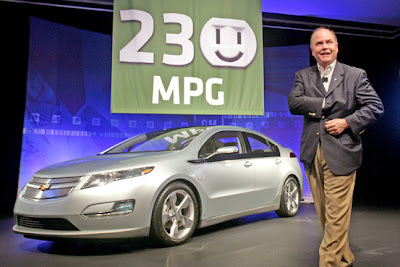 GM's mileage estimate for the Volt promises to start a battle among auto makers as they rush to deliver electric cars, a segment that some executives believe could account for 10% of sales within four years.Nissan Motor Co. plans to launch next year the Leaf, a plug-in hatchback. On Tuesday it responded to the Volt news with a reminder that the Leaf would get a 367-mpg rating under the EPA draft guidelines. But unlike the Volt, the all-electric Leaf will need to be recharged when its battery expires after about 100 miles.
Mr. Henderson acknowledged the Volt's high price, expected at around $40,000, and lack of available public recharging stations are potential challenges. Even with an expected $7,500 tax credit the Volt will cost substantially more than the $22,000 Prius. Charging the batteries should cost owners about 88 cents on average, GM said.
The Volt will be unprofitable for GM at launch because of the high costs of its development and the batteries. GM is counting on economies of scale to make the vehicle profitable eventually.
The new GM board has said it wants management to accelerate product launches. Coming models include high-end compact cars for Buick and Cadillac, a convertible version of the Chevrolet Camaro and a revamped Chevrolet Aveo subcompact.
Mr. Henderson said GM remains on track to have positive net cash flow next year and post a net profit by 2011. He also said it intends to increase production as the "cash for clunkers" rebates boost demand for its vehicles.
General Motors Co., outlining a raft of new vehicles designed to reinvigorate its lineup, said its much-awaited Chevrolet Volt is expected to get 230 miles per gallon in city driving.
The Volt is at the forefront of GM's efforts to win back lost U.S. market share with 25 product launches by 2011.
At 230 mpg, the Volt would dwarf the fuel economy of any mass-market vehicle on sale today, including Toyota Motor Corp.'s Prius hybrid, which is rated at 51 mpg in city driving. It also could deliver a big boost to GM's efforts to cultivate a green image, a key element of the company's restructuring.
The Volt is set for U.S. launch late next year as a 2011 model. The mileage expectation reflects new methodology for electric and plug-in hybrid cars being finalized by the Environmental Protection Agency that factors in electricity used to try to reach a miles-per-gallon equivalent. The intent is to allow consumers to measure the vehicles against traditional gasoline-powered ones.
The EPA said it hasn't tested the Volt.
The Volt is powered by a lithium-ion battery pack, with a range of about 40 miles, that can be recharged through a traditional power outlet. For longer drives, a small gasoline engine takes over, powering a generator that creates electricity to run the car's motors. The Volt's expected total range on one tank of gas is more than 300 miles, GM said.
Frederick "Fritz" Henderson, GM's chief executive, said at a media event that owners who charge the Volt daily could go days without the gas engine firing up. The U.S. Transportation Department says 80% of Americans commute less than 40 miles a day.
Mr. Henderson added he is confident the Volt's combined city and highway mileage -- the figure commonly used to gauge efficiency -- will be in the triple digits. "Having a car that gets triple-digit fuel economy can and will be a game-changer for us," he said.
 GM's mileage estimate for the Volt promises to start a battle among auto makers as they rush to deliver electric cars, a segment that some executives believe could account for 10% of sales within four years.Nissan Motor Co. plans to launch next year the Leaf, a plug-in hatchback. On Tuesday it responded to the Volt news with a reminder that the Leaf would get a 367-mpg rating under the EPA draft guidelines. But unlike the Volt, the all-electric Leaf will need to be recharged when its battery expires after about 100 miles.
Mr. Henderson acknowledged the Volt's high price, expected at around $40,000, and lack of available public recharging stations are potential challenges. Even with an expected $7,500 tax credit the Volt will cost substantially more than the $22,000 Prius. Charging the batteries should cost owners about 88 cents on average, GM said.
The Volt will be unprofitable for GM at launch because of the high costs of its development and the batteries. GM is counting on economies of scale to make the vehicle profitable eventually.
The new GM board has said it wants management to accelerate product launches. Coming models include high-end compact cars for Buick and Cadillac, a convertible version of the Chevrolet Camaro and a revamped Chevrolet Aveo subcompact.
Mr. Henderson said GM remains on track to have positive net cash flow next year and post a net profit by 2011. He also said it intends to increase production as the "cash for clunkers" rebates boost demand for its vehicles.
16 July 2009
Rolling Out 'Cash for Clunkers'
Car Dealers Set Up Hotlines, Web Sites but Fret That Strict Rules Will Hurt Trade-Ins
By The Wall Street Journal
Auto dealers are starting to ramp up advertising built around the government's "cash for clunkers" program, even as they are growing more concerned that the incentives won't provide enough of a spark to revive U.S. auto sales.
Restrictions on eligibility combined with delays in launching the program -- which promises rebates as high as $4,500 -- have quashed hopes that the U.S. will see the same sort of car-shopping craze experienced by countries such as Germany and Brazil that implemented similar plans.
Cash-for-clunkers, formally known as the Car Allowance Rebate System, will provide about $1 billion in federal funds as incentive money. Eligible owners of gas guzzlers will receive a credit if they turn them in and buy or lease a new, more fuel-efficient vehicle.
 The program was approved June 1, but final details on eligibility have yet to be released. That information is expected "on or around" July 24, according to the program's Web site, www.cars.gov.
Dealers are gearing up with online and newspaper ads inviting potential buyers to stop by and see if they are eligible. Some dealers have set up special Web sites. But the lag between passage of the measure by Congress last month and implementation has cooled consumer sentiment, dealers across the country say.
Preliminary rules saying clunkers must be less than 25 years old and get 18 miles per gallon or less in combined city/highway mileage also have hurt.
"We like the idea behind the program; however, the eligibility could be a little too strict and may keep some of my people away," said Alan Helfman, vice president of Houston's River Oaks Chrysler-Jeep.
The program might boost sales by 175,000 vehicles in 2009, said IHS Global Insight analyst Rebecca Lindland. That isn't much help given the hole the industry is in. U.S. auto sales ran at an annualized rate of 9.69 million vehicles in the first six months of the year, down from 13.69 million in the same months of 2008.
 "And these will be sales that are pulled ahead and not new demand," Ms. Lindland said. "We don't see that many people willing to trade in to take on new debt."
Ford Motor Co. and General Motors Co. have rolled out Web sites dedicated to answering questions. Ford has also established a 1-800 hotline. "We have seen 300,000 people go to the Ford.com site to check their eligibility," said Jim Farley, Ford's marketing chief. "We are seeing customers at least coming in and talking to dealers about it."
Hyundai Motor Corp. dealers are already starting to offer discounts based on the expected rebates, funded by loans from Hyundai that cover the difference until the program officially starts.
The National Automobile Dealers Association is encouraging dealers not to make any offers until the final details of the program are known so they don't put their own money at risk.
The clunkers program will run through Nov. 1 or until the funds are exhausted. A similar program in Germany drew more than one million applications for vouchers. That program, at $6.5 billion, is larger than the U.S. version.
By The Wall Street Journal
Auto dealers are starting to ramp up advertising built around the government's "cash for clunkers" program, even as they are growing more concerned that the incentives won't provide enough of a spark to revive U.S. auto sales.
Restrictions on eligibility combined with delays in launching the program -- which promises rebates as high as $4,500 -- have quashed hopes that the U.S. will see the same sort of car-shopping craze experienced by countries such as Germany and Brazil that implemented similar plans.
Cash-for-clunkers, formally known as the Car Allowance Rebate System, will provide about $1 billion in federal funds as incentive money. Eligible owners of gas guzzlers will receive a credit if they turn them in and buy or lease a new, more fuel-efficient vehicle.
 The program was approved June 1, but final details on eligibility have yet to be released. That information is expected "on or around" July 24, according to the program's Web site, www.cars.gov.
Dealers are gearing up with online and newspaper ads inviting potential buyers to stop by and see if they are eligible. Some dealers have set up special Web sites. But the lag between passage of the measure by Congress last month and implementation has cooled consumer sentiment, dealers across the country say.
Preliminary rules saying clunkers must be less than 25 years old and get 18 miles per gallon or less in combined city/highway mileage also have hurt.
"We like the idea behind the program; however, the eligibility could be a little too strict and may keep some of my people away," said Alan Helfman, vice president of Houston's River Oaks Chrysler-Jeep.
The program might boost sales by 175,000 vehicles in 2009, said IHS Global Insight analyst Rebecca Lindland. That isn't much help given the hole the industry is in. U.S. auto sales ran at an annualized rate of 9.69 million vehicles in the first six months of the year, down from 13.69 million in the same months of 2008.
 "And these will be sales that are pulled ahead and not new demand," Ms. Lindland said. "We don't see that many people willing to trade in to take on new debt."
Ford Motor Co. and General Motors Co. have rolled out Web sites dedicated to answering questions. Ford has also established a 1-800 hotline. "We have seen 300,000 people go to the Ford.com site to check their eligibility," said Jim Farley, Ford's marketing chief. "We are seeing customers at least coming in and talking to dealers about it."
Hyundai Motor Corp. dealers are already starting to offer discounts based on the expected rebates, funded by loans from Hyundai that cover the difference until the program officially starts.
The National Automobile Dealers Association is encouraging dealers not to make any offers until the final details of the program are known so they don't put their own money at risk.
The clunkers program will run through Nov. 1 or until the funds are exhausted. A similar program in Germany drew more than one million applications for vouchers. That program, at $6.5 billion, is larger than the U.S. version.
05 July 2009
Blue Cross Grants Additional $6 Million To MHA
Story from Crain's Detroit Business
Blue Cross Blue Shield of Michigan has decided to provide a second $6 million grant to the Michigan Health and Hospital Association for research to improve health care quality and patient safety, and to reduce costs.
 The Blues made an initial $6 million grant in 2004.
The funding will go to MHA’s Keystone Center for Patient Safety and Quality.
“The MHA Keystone Center projects have already delivered a phenomenal return in improving safety and quality,” said Blue Cross CEO Dan Loepp in a statement.
Most of Michigan’s 144 hospitals have participated in the center’s projects – that include reducing hospital-acquired infections, improving care for mothers and newborns and increasing patient flow in emergency departments.
For example, improving quality in hospital intensive care units the past four years have saved 1,800 lives, cut 129,000 hospital days and saved $247 million in unnecessary costs, Blue Cross said.
Hospitals also have saved more than $10 million by reducing urinary tract infections acquired from hospital catheters.
Spencer Johnson, MHA president, said patient lives have been saved by following best practices discovered through the research.
“The Michigan hospitals that participate in the MHA Keystone Center programs have achieved significant, measurable patient safety improvements – errors have been reduced and lives have been saved,” said Johnson in a statement.
Blue Cross Blue Shield of Michigan has decided to provide a second $6 million grant to the Michigan Health and Hospital Association for research to improve health care quality and patient safety, and to reduce costs.
 The Blues made an initial $6 million grant in 2004.
The funding will go to MHA’s Keystone Center for Patient Safety and Quality.
“The MHA Keystone Center projects have already delivered a phenomenal return in improving safety and quality,” said Blue Cross CEO Dan Loepp in a statement.
Most of Michigan’s 144 hospitals have participated in the center’s projects – that include reducing hospital-acquired infections, improving care for mothers and newborns and increasing patient flow in emergency departments.
The Center's projects include reducing hospital-acquired infections, improving care for mothers and newborns and increasing patient flow in emergency departments.
For example, improving quality in hospital intensive care units the past four years have saved 1,800 lives, cut 129,000 hospital days and saved $247 million in unnecessary costs, Blue Cross said.
Hospitals also have saved more than $10 million by reducing urinary tract infections acquired from hospital catheters.
Spencer Johnson, MHA president, said patient lives have been saved by following best practices discovered through the research.
“The Michigan hospitals that participate in the MHA Keystone Center programs have achieved significant, measurable patient safety improvements – errors have been reduced and lives have been saved,” said Johnson in a statement.
Spartan Stores To Highlight 2,400 Michigan Products
 Story from the Detroit News
Grand Rapids, Mich. -- Spartan Stores Inc. is launching a campaign aimed at promoting Michigan pride.
The Grand Rapids-based supermarket chain's Michigan's Best campaign will highlight more than 2,400 products in its stores that are grown or produced in the state. The promotion starts Sunday.
"There has been quite a lot of buzz about buying local and buying Michigan," said Alan Hartline, vice president of merchandising. "We are always trying to position our products to be relevant to customers."
Signs will identify Michigan products throughout Spartan's D&W Fresh Market, Family Fare, Felpausch, Glen's, Glen's Fresh Market and VG's stores in the state, The Grand Rapids Press reported.
Hartline estimates that about 10 percent of products sold in Spartan-owned stores have a Michigan connection. For Spartan-brand products, about 20 percent of sales are Michigan products.
In recent years, some Michigan grocers have emphasized homegrown and organic fruit and vegetables. Spartan also has invited Michigan companies to give product demonstrations throughout the summer.
The retailer has been a leader in highlighting Michigan brands over the years, said Bruce Kratt, director of sales and marketing for Hudsonville Ice Cream, which employs 22 people in Holland.
"It's great for companies like ours," Kratt said.
02 July 2009
GM Sheds The Corporate Jets
 Story from the Wall Street Journal
GM, as part of its restructuring in bankruptcy, is looking to rid itself of its leases on seven corporate jets and its hangar at Detroit Metropolitan Airport, according to a motion filed in court.
The company is asking a judge to let it terminate the leases because it says it doesn’t plan to sell them to the New GM and that “the Debtors have determined that rejecting the Leases and surrendering possession of the property to the relevant lessor is in the best interests of their estates.”
Five of the jets are medium-range Gulfstream G-IVs, leased from AVN Air LLC. Two are longer-range Gulfstream G-Vs, leased from Suntrust Corp.
Lawmakers criticized the CEOs of GM, Ford, and Chrysler when the trio flew to Washington on separate private jets — as Auto Tracker first reported in November — to ask for government support for the auto industry. On a second trip, the executives drove to the capital from Detroit.
Among the leases GM is seeking to terminate is one for the G-IV with the tail number N5116 that was spotted by ABC News at Washington’s Dulles airport during the testimony of then- CEO Rick Wagoner in Congress.
After last fall’s public relations debacle, GM said it was returning two of its seven planes to the leasing company, which it declined to name at the time. It said it had returned two others in September.
GM Employees Get A Letter From The CEO
Story from the Wall Street Journal
Full text of GM CEO Fritz Henderson's letter to employees on the auto maker's bankruptcy filing:
 June 1, 2009
GM Employees:
Today marks a defining moment in the history of General Motors. This morning, we announced an agreement with U.S. Treasury and Canadian and Ontario governments – which along with the recent agreements with the UAW and CAW unions, and sacrifices by our salaried employees and -- will allow us to form a leaner, more customer-focused, more cost-competitive company -- a "New GM" built upon the strongest parts of our business, with far less debt, lower operating costs and the ability to generate sustained and winning bottom-line performance.
To implement these agreements and launch the New GM, it was necessary to enter a court-supervised process, which we did earlier this morning with the full support of the U.S. and Canadian governments. While we preferred other paths to our goal, what is most important is our destination and getting there fast. The court process we're pursuing gives us powerful tools to accelerate and complete the job of reinventing GM. It also provides strong safeguards to our customers and our business between now and the time the New GM is launched as an independent company, which we expect will be in about 60 to 90 days.
As you know, the actions we've taken to create a New GM include some very difficult steps. Today, we're identifying the 14 manufacturing plants that will be impacted by our accelerated plan to improve our capacity utilization, as called for in our April 27 viability plan. These facilities include our Pontiac and Wilmington assembly plants, our Grand Rapids, Indianapolis, and Mansfield Metal stamping plants and our Livonia Engine, Flint North Components, Willow Run, Parma Components and Fredericksburg Components and Massena Castings powertrain plants. Our Orion and Spring Hill assembly plants will be placed in "standby capacity" status, along with the Pontiac Metal stamping plant. In addition, Janesville Assembly plant's status has been changed from closed to standby capacity. And, our Boston, Jacksonville, and Columbus SPO facilities will cease operations by December 31, 2009. In line with our structural cost reductions and the reinvention of our company, we're announcing plans to further reduce our North American salaried employment by 5,100 this year, including 4,000 in the United States. After completing these reductions, we will have reduced North American employment by 7,900 – or 22 percent this year.
GM will remain open for business during this period. All employees will be paid in the normal course and work as members of the New GM team. The only exception is the amount of non-qualified pension for some executive retirees. We also will reduce some retiree benefits for salaried retirees (those retired now and those who will retire in the future) and non-UAW retirees (those retired now and those who will retire in the future). We are continuing to determine how these changes will be made and we will communicate to the affected employees and retirees as soon as decisions are made. We intend to address this matter as quickly as we can.
Our warranty, service and customer support activities will continue uninterrupted, with U.S. government guarantees. New products and advanced-technology launches will continue on schedule, and all GM facilities will operate on the same basis they did yesterday, with no changes to the scheduled downtime calendar.
I've attached the news release we issued announcing these steps. Please read it carefully, but I want to share a few thoughts about today's news. I encourage you to share them with family, friends and others with a stake in GM's future:
* We're on a proven path. The process we're using to launch the New GM is an established and effective approach. While we expect that some parties will register objections during the court-supervised process, we are well prepared and confident that we will achieve our goals.
* We're committed to our April 27th viability plan. The plan we described in April, along with some additional initiatives, is New GM's plan.
* We remain a vital part of the global auto industry. Thanks to the difficult work we have done in recent years, GM has world-class assets that are highly valuable to consumers, stakeholders and the economy. We have developed a line-up of award-winning vehicles and a pipeline of exciting new products that customers want. We have substantial investments in important green technologies. Our smaller, stronger dealer network will raise the standards for customer service. And, we will remain a global company, with a tremendous work force.
* We're here to stay, and we will succeed by taking care of our customers. We have endured trying times together. The pain has been shouldered by many, and our April 27th viability plan asks for even more from us. But make no mistake – today's actions are designed to reinvent GM for sustained success. From here we move on, and we move up. New GM can and will win, and we will do it by putting our customers first.
We understand that you will have many questions throughout this transition process. Further information is available on Socrates or at GM.com/restructuring. Both will be updated often as new information becomes available. I also encourage you to visit GMreinvention.com and share it with others who have an interest in GM's future.
We also recognize that the further changes necessary to complete GM's reinvention must come from within the company. With that thought in mind, I'll post an Employee Blog later today with some of my thoughts about what we need to change at GM, and how we'll make them happen. I look forward to your feedback.
Along with our leadership team and Board of Directors, I am consistently inspired by your resilience and resolve. We know you will continue to rise to the occasion. Thank you for everything you have done and will do for GM.
Fritz
Full text of GM CEO Fritz Henderson's letter to employees on the auto maker's bankruptcy filing:
 June 1, 2009
GM Employees:
Today marks a defining moment in the history of General Motors. This morning, we announced an agreement with U.S. Treasury and Canadian and Ontario governments – which along with the recent agreements with the UAW and CAW unions, and sacrifices by our salaried employees and -- will allow us to form a leaner, more customer-focused, more cost-competitive company -- a "New GM" built upon the strongest parts of our business, with far less debt, lower operating costs and the ability to generate sustained and winning bottom-line performance.
To implement these agreements and launch the New GM, it was necessary to enter a court-supervised process, which we did earlier this morning with the full support of the U.S. and Canadian governments. While we preferred other paths to our goal, what is most important is our destination and getting there fast. The court process we're pursuing gives us powerful tools to accelerate and complete the job of reinventing GM. It also provides strong safeguards to our customers and our business between now and the time the New GM is launched as an independent company, which we expect will be in about 60 to 90 days.
As you know, the actions we've taken to create a New GM include some very difficult steps. Today, we're identifying the 14 manufacturing plants that will be impacted by our accelerated plan to improve our capacity utilization, as called for in our April 27 viability plan. These facilities include our Pontiac and Wilmington assembly plants, our Grand Rapids, Indianapolis, and Mansfield Metal stamping plants and our Livonia Engine, Flint North Components, Willow Run, Parma Components and Fredericksburg Components and Massena Castings powertrain plants. Our Orion and Spring Hill assembly plants will be placed in "standby capacity" status, along with the Pontiac Metal stamping plant. In addition, Janesville Assembly plant's status has been changed from closed to standby capacity. And, our Boston, Jacksonville, and Columbus SPO facilities will cease operations by December 31, 2009. In line with our structural cost reductions and the reinvention of our company, we're announcing plans to further reduce our North American salaried employment by 5,100 this year, including 4,000 in the United States. After completing these reductions, we will have reduced North American employment by 7,900 – or 22 percent this year.
GM will remain open for business during this period. All employees will be paid in the normal course and work as members of the New GM team. The only exception is the amount of non-qualified pension for some executive retirees. We also will reduce some retiree benefits for salaried retirees (those retired now and those who will retire in the future) and non-UAW retirees (those retired now and those who will retire in the future). We are continuing to determine how these changes will be made and we will communicate to the affected employees and retirees as soon as decisions are made. We intend to address this matter as quickly as we can.
Our warranty, service and customer support activities will continue uninterrupted, with U.S. government guarantees. New products and advanced-technology launches will continue on schedule, and all GM facilities will operate on the same basis they did yesterday, with no changes to the scheduled downtime calendar.
I've attached the news release we issued announcing these steps. Please read it carefully, but I want to share a few thoughts about today's news. I encourage you to share them with family, friends and others with a stake in GM's future:
* We're on a proven path. The process we're using to launch the New GM is an established and effective approach. While we expect that some parties will register objections during the court-supervised process, we are well prepared and confident that we will achieve our goals.
* We're committed to our April 27th viability plan. The plan we described in April, along with some additional initiatives, is New GM's plan.
* We remain a vital part of the global auto industry. Thanks to the difficult work we have done in recent years, GM has world-class assets that are highly valuable to consumers, stakeholders and the economy. We have developed a line-up of award-winning vehicles and a pipeline of exciting new products that customers want. We have substantial investments in important green technologies. Our smaller, stronger dealer network will raise the standards for customer service. And, we will remain a global company, with a tremendous work force.
* We're here to stay, and we will succeed by taking care of our customers. We have endured trying times together. The pain has been shouldered by many, and our April 27th viability plan asks for even more from us. But make no mistake – today's actions are designed to reinvent GM for sustained success. From here we move on, and we move up. New GM can and will win, and we will do it by putting our customers first.
We understand that you will have many questions throughout this transition process. Further information is available on Socrates or at GM.com/restructuring. Both will be updated often as new information becomes available. I also encourage you to visit GMreinvention.com and share it with others who have an interest in GM's future.
We also recognize that the further changes necessary to complete GM's reinvention must come from within the company. With that thought in mind, I'll post an Employee Blog later today with some of my thoughts about what we need to change at GM, and how we'll make them happen. I look forward to your feedback.
Along with our leadership team and Board of Directors, I am consistently inspired by your resilience and resolve. We know you will continue to rise to the occasion. Thank you for everything you have done and will do for GM.
Fritz
Subscribe to:
Posts (Atom)


