Showing posts with label Blue Cross. Show all posts
Showing posts with label Blue Cross. Show all posts
22 January 2013
Critics may derail fast track for Blue Cross Blue Shield reform
Article first appeared on The Detroit News
Gov. Rick Snyder wants the Legislature to quickly pass Blue Cross Blue Shield reforms, but some critics are demanding a second look that might delay passage and keep the Blues from offering low-cost insurance under the federal health care act.
The Legislature approved a two-bill package in late December. But Snyder vetoed the legislation earlier this month over anti-abortion provisions added minutes before passage in the lame-duck session. The provisions required women to buy separate, elective abortion coverage.
The bills were reintroduced in the Senate on Wednesday without the added language and are likely to breeze through the Senate. It could be tougher in the House, which has more than two dozen new representatives and has yet to make committee assignments.
"We have 26 new people so we can't do a quick thing like the Senate," said Rep. Pete Lund, R-Shelby Township, who last year chaired the House Insurance Committee. The number of Democrats also has increased in the lower chamber, where the GOP has a smaller 59-51 majority.
House Minority Leader Tim Greimel, D-Auburn Hills, said his caucus' concerns include getting continuation of Medigap subsidies for seniors extended beyond the four years in the bills.
"We're interested in making sure that seniors are protected from any unduly high premiums in their Medigap insurance," Greimel said.
Snyder supported turning the Blues into a taxpaying nonprofit mutual insurance company to streamline the rate approval process and increase competition among insurers. Blue Cross dominates with more than 70 percent of the market. The Blues also support the reforms.
But critics contend the proposal does little to inject more competition and would make it easier for the Blues to raise rates for consumers -- meaning little if any money would be saved.
Among the legislation's biggest critics is Attorney General Bill Schuette, who argues the prior legislation failed to protect consumers. The Legislature ignored Schuette's early calls for an independent valuation of the Blues' assets to determine the nonprofit's worth before entering into a deal.
The legislation requires the Blues to contribute $1.5 billion to an independent foundation to carry on their charitable mission, but Schuette questioned if it is a good deal for taxpayers.
Future of Medigap subsidies:
Schuette also fears that seniors would not have the cost of Medigap, secondary insurance to cover costs not paid by Medicare, subsidized beyond 2016.
"The attorney general negotiated a historic Medigap rate freeze, and this legislation does not address what happens when that expires, (when) thousands of seniors could face rate increases of up to 66 percent," Schuette spokeswoman Joy Yearout said.
Blue Cross spokesman Andrew Hetzel counters the legislation guarantees Michigan's lowest-income seniors will continue to get Medigap subsidies for nearly a decade.
"We believe that the legislation provides extraordinary protection for seniors," Hetzel said. "It guarantees not one penny of rate increase in our Medigap product for four more years, and after that the legislation calls for continued subsidy for Medigap for five more years for the lowest-income seniors."
Schuette and at least one business group also worry that the proposal diminishes the attorney general's role to intervene on behalf of taxpayers. Although Michigan is rated the third least competitive state in the nation for health insurance by the American Medical Association, the Blues would receive no more scrutiny than any other insurer.
"If (the attorney general's) oversight is removed," Yearout said, "seniors would no longer have an advocate to keep these rates down."
Still, the legislation Snyder vetoed had important new rules for the insurance industry, said Rick Murdock, executive director of the Michigan Association of Health Plans that represents non-Blues insurers.
They included a prohibition against an insurer contracting with a health system to give it a lower cost that couldn't be offered to another system, and ensuring the Blues pay their fair share of Medicare and Medicaid costs, he said.
If those provisions are kept in the new bills, Murdock would rather get them approved and worry about other changes later.
Leveling the playing field
Though the Blues package, without the abortion language, had bipartisan support, it was opposed by consumers' groups supported by many Democrats, as well as by some business groups.
"I think we'd like to revisit some of these issues," said Charlie Owens, state director of the National Federation of Independent Businesses.
As the state's insurer of last resort, the Blues for decades promised to insure everyone regardless of pre-existing conditions. In return, they've been forgiven roughly $100 million annually in tax payments. But under the federal Affordable Care Act, all health insurers have to insure such patients, so Snyder proposed it lose its special status.
The Blues agreed and want to compete on a level playing field when consumers start purchasing low-cost health insurance on the Michigan Affordable Health Care Exchange on Jan. 1, 2014. Hetzel said it will take about one year from the time the Blues bills are signed into law to complete the transition to a nonprofit mutual insurance company, so the Legislature would have to act now to ensure the Blues are ready at the starting gate, he said.
Time crunch for approval
The first hurdle comes March 31 when all of the state's insurers who wish to participate in the health care exchange must file a description of their products and prices with the federal government. The products have to be approved by the state insurance commissioner under existing rules. That means some products or prices might not get approval by the end of March.
If the Legislature hasn't passed the Blues legislation, "that puts Blue Cross at the huge disadvantage and it puts the insurance commissioner in a very difficult spot," Hetzel said.
State Insurance Commissioner Kevin Clinton agrees there is cause for concern, especially the lengthy eight- to nine-month process the Blues go through to get rates approved.
"They're going to be under a time crunch unless they can come up with a way to have their rates approved faster than they've done in the past," Clinton said. "Certainly you want your state's largest insurer to be on the exchange."

09 December 2011
Blue Cross and Beaumont Battle Hurts Patients
Story first appeared in the Detroit Free Press.
A dispute between the Beaumont Health System and Blue Cross Blue Shield of Michigan is being watched closely all over the state, as health chiefs wonder: Will cardholders with the state's largest insurer still be able to get care at most Michigan hospitals, including a Michigan Heart Hospital?
The fight spilled into the public in October, when the Royal Oak-based hospital system and the Blues took out full-page ads to convey their side of the issue.
If the dispute is not resolved, Beaumont -- starting Jan. 12 -- will no longer will accept the insurance of about 100,000 people insured through Blue Care Network, a Blue Cross subsidiary.
The Blues wants its payments to Beaumont to be based on strong quality and cost-cutting performance goals, rather than on volume of business, as has been the case.
Beaumont insists its care is appropriate for patients, low-cost and high-quality. It would be forced to make cuts that would hurt care if the Blues does not improve its rates to the hospital system including a Detroit Hospital, executives say.
Rick Murdock, executive director of the Michigan Association of Health Plans, a nonprofit organization of HMOs and health care organizations, said other hospitals are watching the fight. It just could signal a new time when the Blues' card is not accepted everywhere, he said.
Dispute gets nastier as deadline for deal nears
David Stock wants his doctors, not insurance companies, to make the decision about the best place for him to get care.
He wants a physician telling him he needs a test and where to get it, not my insurance company, said Stock, 49, who lives seven blocks from Beaumont Hospital in Royal Oak.
Stock is one of about 100,000 metro Detroit residents who may be forced to seek care at another hospital like a Michigan Cancer Hospital if a dispute drawing statewide and national attention is not resolved by Dec. 31.
With time running out to agree on a new contract with Blue Cross Blue Shield of Michigan, the three-hospital Beaumont Health System escalated an unusually public fight with the insurer this week, sending a team of executives to discuss the rate-increase dispute with Michigan insurance commissioner Kevin Clinton and other legislators.
Since mid-October, Beaumont and Blues executives have sparred about who's to blame for a stalemate at the bargaining table over a new three-year contract regarding what the insurer will pay for care rendered at Beaumont facilities.
The fight already is affecting care, charged Dr. Sam Flanders, Beaumont's chief quality officer. Some patients needing prior approval for tests and visits to specialists are finding delays getting the OKs, Flanders said. The Blues deny the charge.
If the dispute is not resolved, starting Jan. 12, Beaumont will no longer accept the insurance of about 100,000 people insured through Blue Care Network, a Blue Cross subsidiary.
Beaumont's emergency department would continue to see Blue Care Network patients but once stabilized, as required by federal law, there's a chance patients would be transferred elsewhere for additional care or tests, Flanders said.
Beaumont wants a 9% increase over three years. The Blues have offered 3.5%, along with a 2.5% increase all hospitals would receive in 2012. This may also be for a Michigan Rehab Hospital.
Possible impact on care
Citing research by a consortium of academically affiliated hospital systems, Beaumont said its costs are much lower than those of many like it. Beaumont officials said that without a boost in rates from the Blues, they will be forced to make cuts in care.
Dr. David Share, a Blues vice president overseeing its quality initiatives to improve care, said that though many Beaumont services are lower-priced, the hospital system overuses costlier programs, such as ultrasound stress tests for heart problems and radiation-sparring treatments for cancer.
Share also said that the number of services patients get at Beaumont are significantly higher, driving up the patient's cost. This does not apply to those who go to elsewhere like a Chicago Weight Loss center.
Both Beaumont and the Blues have taken out full-page ads in metro Detroit newspapers, including the Free Press, a media strategy that Beaumont CEO Gene Michalski called very un-Beaumont-like, a reference to the health system's more conservative corporate profile.
Several hundred Beaumont patients have called the Blues to complain, including seniors with Blue Cross Medicare plans not affected, at least not yet, by the fight.
New payment measure
Sue Barkell, senior vice president for health care value for the Blues, said the insurer is taking a "new direction" in negotiations with all Michigan hospitals to base payments on performance not volume of business, as it has in the past. She said the insurer's motive is cost control and a focus on quality, but there's no plan to limit hospitals in its network, as health maintenance organizations always have done as a way to rein in costs.
Some 40% of the contracts with Michigan's 144 acute-care hospitals will expire in 2012, she said. Beaumont is merely the first of the first two or three hospitals to participate in talks centered on new quality measurements.
This isn't about an insurance company squeezing a hospital, Blues spokesman Andy Hetzel said. It's about how to pay in the future ... to try to bend the cost curve.
Not just Michigan issue
The dispute is being watched all over the state and country. Health care experts expect other disputes to surface with insurers, as a few already have.
Two years ago, Blue Cross Blue Shield of Illinois ended its contract between its HMO subsidiary and the Rush University Medical Center in Chicago, though the 769,000 patients in the plan still can get certain care at Rush if a doctor approves them to receive out-of-network care. Some care requires consumers to pay higher costs for care considered out-of-network.
In Massachusetts, Tufts Medical Center and its state Blues plan recently agreed to resume negotiations with a third party. All other details of the talks are confidential, a Tufts spokeswoman said.
And in California, Stanford Hospital & Clinics and California's Anthem Blue Plan just resolved a protracted contract dispute. Each has declined to reveal details about the new contract.
Rick Murdock, executive director of the Michigan Association of Health Plans, a statewide organization of mostly HMOs and other health providers, said other Michigan hospitals wonder whether the Beaumont and Blues fight is the beginning of a time when large insurers may attempt to sign contracts only with hospitals that meet cost-cutting and quality-of-care goals.
The Blues already gives deep discounts to some hospitals that agree not to accept other insurance, a practice under challenge by the U.S. Justice Department. That lawsuit against the Michigan Blues is pending in federal court in Detroit. The insurer, which considers the case groundless, has lost its attempts to dismiss the case so far.
Hazy patient situation
Until more hospitals publicly post prices -- now only Oakwood Healthcare in Dearborn and Spectrum Health in Grand Rapids routinely do in Michigan -- consumers won't be able to understand whether a hospital charges too much or whether an insurer is denying them access to a hospital because it's too costly, said Lody Zwarensteyn, the longtime CEO of Alliance for Michigan.
The alliance is a Grand Rapids-based health planning group responsible for a landmark federal ruling that led to more competitive pricing there in the 1990s.
A dispute between the Beaumont Health System and Blue Cross Blue Shield of Michigan is being watched closely all over the state, as health chiefs wonder: Will cardholders with the state's largest insurer still be able to get care at most Michigan hospitals, including a Michigan Heart Hospital?
The fight spilled into the public in October, when the Royal Oak-based hospital system and the Blues took out full-page ads to convey their side of the issue.
If the dispute is not resolved, Beaumont -- starting Jan. 12 -- will no longer will accept the insurance of about 100,000 people insured through Blue Care Network, a Blue Cross subsidiary.
The Blues wants its payments to Beaumont to be based on strong quality and cost-cutting performance goals, rather than on volume of business, as has been the case.
Beaumont insists its care is appropriate for patients, low-cost and high-quality. It would be forced to make cuts that would hurt care if the Blues does not improve its rates to the hospital system including a Detroit Hospital, executives say.
Rick Murdock, executive director of the Michigan Association of Health Plans, a nonprofit organization of HMOs and health care organizations, said other hospitals are watching the fight. It just could signal a new time when the Blues' card is not accepted everywhere, he said.
Dispute gets nastier as deadline for deal nears
David Stock wants his doctors, not insurance companies, to make the decision about the best place for him to get care.
He wants a physician telling him he needs a test and where to get it, not my insurance company, said Stock, 49, who lives seven blocks from Beaumont Hospital in Royal Oak.
Stock is one of about 100,000 metro Detroit residents who may be forced to seek care at another hospital like a Michigan Cancer Hospital if a dispute drawing statewide and national attention is not resolved by Dec. 31.
With time running out to agree on a new contract with Blue Cross Blue Shield of Michigan, the three-hospital Beaumont Health System escalated an unusually public fight with the insurer this week, sending a team of executives to discuss the rate-increase dispute with Michigan insurance commissioner Kevin Clinton and other legislators.
Since mid-October, Beaumont and Blues executives have sparred about who's to blame for a stalemate at the bargaining table over a new three-year contract regarding what the insurer will pay for care rendered at Beaumont facilities.
The fight already is affecting care, charged Dr. Sam Flanders, Beaumont's chief quality officer. Some patients needing prior approval for tests and visits to specialists are finding delays getting the OKs, Flanders said. The Blues deny the charge.
If the dispute is not resolved, starting Jan. 12, Beaumont will no longer accept the insurance of about 100,000 people insured through Blue Care Network, a Blue Cross subsidiary.
Beaumont's emergency department would continue to see Blue Care Network patients but once stabilized, as required by federal law, there's a chance patients would be transferred elsewhere for additional care or tests, Flanders said.
Beaumont wants a 9% increase over three years. The Blues have offered 3.5%, along with a 2.5% increase all hospitals would receive in 2012. This may also be for a Michigan Rehab Hospital.
Possible impact on care
Citing research by a consortium of academically affiliated hospital systems, Beaumont said its costs are much lower than those of many like it. Beaumont officials said that without a boost in rates from the Blues, they will be forced to make cuts in care.
Dr. David Share, a Blues vice president overseeing its quality initiatives to improve care, said that though many Beaumont services are lower-priced, the hospital system overuses costlier programs, such as ultrasound stress tests for heart problems and radiation-sparring treatments for cancer.
Share also said that the number of services patients get at Beaumont are significantly higher, driving up the patient's cost. This does not apply to those who go to elsewhere like a Chicago Weight Loss center.
Both Beaumont and the Blues have taken out full-page ads in metro Detroit newspapers, including the Free Press, a media strategy that Beaumont CEO Gene Michalski called very un-Beaumont-like, a reference to the health system's more conservative corporate profile.
Several hundred Beaumont patients have called the Blues to complain, including seniors with Blue Cross Medicare plans not affected, at least not yet, by the fight.
New payment measure
Sue Barkell, senior vice president for health care value for the Blues, said the insurer is taking a "new direction" in negotiations with all Michigan hospitals to base payments on performance not volume of business, as it has in the past. She said the insurer's motive is cost control and a focus on quality, but there's no plan to limit hospitals in its network, as health maintenance organizations always have done as a way to rein in costs.
Some 40% of the contracts with Michigan's 144 acute-care hospitals will expire in 2012, she said. Beaumont is merely the first of the first two or three hospitals to participate in talks centered on new quality measurements.
This isn't about an insurance company squeezing a hospital, Blues spokesman Andy Hetzel said. It's about how to pay in the future ... to try to bend the cost curve.
Not just Michigan issue
The dispute is being watched all over the state and country. Health care experts expect other disputes to surface with insurers, as a few already have.
Two years ago, Blue Cross Blue Shield of Illinois ended its contract between its HMO subsidiary and the Rush University Medical Center in Chicago, though the 769,000 patients in the plan still can get certain care at Rush if a doctor approves them to receive out-of-network care. Some care requires consumers to pay higher costs for care considered out-of-network.
In Massachusetts, Tufts Medical Center and its state Blues plan recently agreed to resume negotiations with a third party. All other details of the talks are confidential, a Tufts spokeswoman said.
And in California, Stanford Hospital & Clinics and California's Anthem Blue Plan just resolved a protracted contract dispute. Each has declined to reveal details about the new contract.
Rick Murdock, executive director of the Michigan Association of Health Plans, a statewide organization of mostly HMOs and other health providers, said other Michigan hospitals wonder whether the Beaumont and Blues fight is the beginning of a time when large insurers may attempt to sign contracts only with hospitals that meet cost-cutting and quality-of-care goals.
The Blues already gives deep discounts to some hospitals that agree not to accept other insurance, a practice under challenge by the U.S. Justice Department. That lawsuit against the Michigan Blues is pending in federal court in Detroit. The insurer, which considers the case groundless, has lost its attempts to dismiss the case so far.
Hazy patient situation
Until more hospitals publicly post prices -- now only Oakwood Healthcare in Dearborn and Spectrum Health in Grand Rapids routinely do in Michigan -- consumers won't be able to understand whether a hospital charges too much or whether an insurer is denying them access to a hospital because it's too costly, said Lody Zwarensteyn, the longtime CEO of Alliance for Michigan.
The alliance is a Grand Rapids-based health planning group responsible for a landmark federal ruling that led to more competitive pricing there in the 1990s.
10 November 2010
Inside a $4.5M Court Award: Lawsuit questions Blue Cross' Power
The Detroit Free Press
Therapy program fight raises red flags about giant's reach
 Blue Cross Blue Shield of Michigan -- a nonprofit created to keep health costs affordable -- has tried to derail physical therapy programs designed to save auto giants Ford and Chrysler millions of dollars annually, according to a review of hundreds of pages of e-mails and internal documents produced in a lawsuit against Blue Cross.
Blue Cross, the state's largest health insurer, strongly denies the allegations.
Yet an Oakland County jury disagreed this summer, finding the insurer wrongfully interfered with physical therapy firm TheraMatrix's efforts to create a program for Chrysler. TheraMatrix was awarded $4.5 million. Blue Cross has appealed.
Now, antitrust investigators at the Michigan Attorney General's Office and the U.S. Justice Department are reviewing records in the case, along with other practices by the Blues. Competitors say Blue Cross is so powerful that it negotiates deals with hospitals others don't get -- driving up health costs to customers insured by other companies.
Together, these issues have put Michigan in a national spotlight.
The tale of Pontiac-based TheraMatrix's efforts to carve out a cost-saving physical therapy program for some of the nation's largest employers raises larger questions about whether relationships between insurers and hospitals are inflating the cost of health care and stifling competition critical to controlling costs under the nation's new health law.
"It's really an exposure of the entire health care situation in this state," said Robert Whitton, TheraMatrix's CEO.
Inside a $4.5M court award
As health care costs soared nationwide, a small Michigan firm gave Ford a proposal to cut its physical therapy costs. The automaker signed up for an instate pilot program, which was so successful Ford expanded it last year to cover about 390,000 employees, retirees and their families nationwide.
Yet the cost-saving program created by Pontiac-based TheraMatrix has come under attack from Blue Cross Blue Shield of Michigan.
Court records allege Blue Cross used its position as the state's dominant insurer to try to crush TheraMatrix as it worked also to sign up Chrysler and General Motors. A USA Today review of hundreds of pages of e-mails and internal documents that are part of a lawsuit TheraMatrix filed against Blue Cross indicates that TheraMatrix's efforts to carve out a niche market in managing outpatient physical therapy costs was seen as a threat by officials at Blue Cross and by some Michigan hospitals.
"They tried to destroy us," said Robert Whitton, a physical therapist who founded TheraMatrix in 1981. TheraMatrix has cut Ford's physical therapy costs by about half, Whitton says, saving millions of dollars annually. Under Blue Cross, Ford's costs averaged $745,000 a month just in Michigan, he said. "We shouldn't have been in this position for creating a program that helped save health care costs."
As health care costs soared nationwide, a small Michigan firm gave Ford a proposal to cut its physical therapy costs. The automaker signed up for an instate pilot program, which was so successful Ford expanded it last year to cover about 390,000 employees, retirees and their families nationwide.
Yet the cost-saving program created by Pontiac-based TheraMatrix has come under attack from Blue Cross Blue Shield of Michigan.
Court records allege Blue Cross used its position as the state's dominant insurer to try to crush TheraMatrix as it worked also to sign up Chrysler and General Motors. A USA Today review of hundreds of pages of e-mails and internal documents that are part of a lawsuit TheraMatrix filed against Blue Cross indicates that TheraMatrix's efforts to carve out a niche market in managing outpatient physical therapy costs was seen as a threat by officials at Blue Cross and by some Michigan hospitals.
"They tried to destroy us," said Robert Whitton, a physical therapist who founded TheraMatrix in 1981. TheraMatrix has cut Ford's physical therapy costs by about half, Whitton says, saving millions of dollars annually. Under Blue Cross, Ford's costs averaged $745,000 a month just in Michigan, he said. "We shouldn't have been in this position for creating a program that helped save health care costs."
A different picture
Blue Cross denies trying to hurt TheraMatrix's business.
"The picture that they're trying to paint is the big whatever giant with a chainsaw in his hand coming down on the little guy," said Jeffrey Rumley, Blue Cross' general counsel. "I just don't buy into that too easily."
Court records depict Blue Cross -- a nonprofit created under Michigan law to provide affordable health care -- as working with a major hospital to stop expansion of TheraMatrix's program. They also reveal that Blue Cross barred TheraMatrix from the insurer's medical provider network, which covers most Michigan patients.
An Oakland County jury awarded TheraMatrix $4.5 million in July, finding that Blue Cross breached an agreement with TheraMatrix to process claims for its Ford program, then wrongfully interfered with TheraMatrix's efforts to launch a Chrysler program. Blue Cross has appealed.
Last month, the U.S. Justice Department sued Michigan's Blue Cross, accusing the insurer of a different kind of anticompetitive behavior: paying hospitals higher prices for medical care in exchange for a promise they would charge competing insurers as much as 40% more than they charge Blue Cross. Blue Cross says the suit is without merit.
Blue Cross denies trying to hurt TheraMatrix's business.
"The picture that they're trying to paint is the big whatever giant with a chainsaw in his hand coming down on the little guy," said Jeffrey Rumley, Blue Cross' general counsel. "I just don't buy into that too easily."
Court records depict Blue Cross -- a nonprofit created under Michigan law to provide affordable health care -- as working with a major hospital to stop expansion of TheraMatrix's program. They also reveal that Blue Cross barred TheraMatrix from the insurer's medical provider network, which covers most Michigan patients.
An Oakland County jury awarded TheraMatrix $4.5 million in July, finding that Blue Cross breached an agreement with TheraMatrix to process claims for its Ford program, then wrongfully interfered with TheraMatrix's efforts to launch a Chrysler program. Blue Cross has appealed.
Last month, the U.S. Justice Department sued Michigan's Blue Cross, accusing the insurer of a different kind of anticompetitive behavior: paying hospitals higher prices for medical care in exchange for a promise they would charge competing insurers as much as 40% more than they charge Blue Cross. Blue Cross says the suit is without merit.
A battle over business
TheraMatrix's battles with Blue Cross go back to 2005. That's when Ford decided to try to save money by carving out physical therapy benefits from an employee health plan administered by Blue Cross. That February, Ford hired TheraMatrix to manage that aspect for its Michigan employees.
At the time, physical therapy spending for all Michigan Blue Cross customers was increasing by almost 17% a year, an internal Blue Cross report shows.
TheraMatrix saved Ford money by creating a network of physical therapists willing to accept $68 per visit --significantly less than what Ford had been paying under Blue Cross. TheraMatrix also reviews treatment plans so patients don't get too many or too few visits.
But the project nearly was derailed when Blue Cross said it couldn't process claims for TheraMatrix, records show. About the same time, TheraMatrix alleges, Blue Cross decided to create its own discount physical therapy network.
Ford kept TheraMatrix; the program began in August 2005.
Michigan hospitals, which provide outpatient physical therapy, weren't happy about the lost business, records indicate.
TheraMatrix's battles with Blue Cross go back to 2005. That's when Ford decided to try to save money by carving out physical therapy benefits from an employee health plan administered by Blue Cross. That February, Ford hired TheraMatrix to manage that aspect for its Michigan employees.
At the time, physical therapy spending for all Michigan Blue Cross customers was increasing by almost 17% a year, an internal Blue Cross report shows.
TheraMatrix saved Ford money by creating a network of physical therapists willing to accept $68 per visit --significantly less than what Ford had been paying under Blue Cross. TheraMatrix also reviews treatment plans so patients don't get too many or too few visits.
But the project nearly was derailed when Blue Cross said it couldn't process claims for TheraMatrix, records show. About the same time, TheraMatrix alleges, Blue Cross decided to create its own discount physical therapy network.
Ford kept TheraMatrix; the program began in August 2005.
Michigan hospitals, which provide outpatient physical therapy, weren't happy about the lost business, records indicate.
A string of urgent e-mails
By early 2006, Chrysler, which also used Blue Cross to administer its health plan, was looking to hire TheraMatrix. This set off a series of urgent e-mails among top Blue Cross executives, court records show.
David Kee, head of Blue Cross' Chrysler account, warned: "we need to do something fast and dramatic." His strategy included showing that Chrysler could lose its hospital discounts if it went with TheraMatrix. "I think a carefully worded document, perhaps from the hospitals themselves, could be valuable," he wrote.
About a week later, e-mails show, such a letter was being offered by Beaumont Hospitals Vice President Mark Johnson -- who had been a Blue Cross vice president before joining the metro Detroit hospital system in 2004.
Blue Cross Vice President Kim Sorget said in reply that Kee could "use the letter as leverage with his customer to not proceed with the carve out."
In August, after the TheraMatrix trial, Blue Cross rehired Johnson as a vice president. Blue Cross said Johnson, Kee and Sorget were unavailable for comment.
Beaumont spokesman Mike Killian said the hospital system had a financial duty as a nonprofit to stop honoring the discounts if necessary. When Ford went with TheraMatrix, it cost Beaumont $400,000 a year, Johnson testified at trial. Beaumont facilities would have lost $2 million a year if Chrysler and GM had followed suit, he said.
In spring 2006, Chrysler and the UAW agreed TheraMatrix would start managing physical therapy for the automaker around July 1.
Two weeks later, Blue Cross kicked TheraMatrix out of the insurer's provider network, which meant a huge loss of patients and doctor referrals.
"It was devastating," said TheraMatrix President Bob Read. Blue Cross controls more than 60% of Michigan's insurance market, covering nine times as many people as its closest competitor.
Blue Cross refused for more than a year to let TheraMatrix back into its provider network, and the Chrysler program became critical to TheraMatrix's survival, Whitton said.
Beaumont Hospitals gave Blue Cross the letter about potentially canceling discounts for Chrysler and Ford on June 26, 2006.
The next month, Chrysler decided not to go forward with the program. Chrysler spokesman Michael Palese said the company had no comment.
Blue Cross, in court records, contends TheraMatrix hasn't proven the insurer's actions influenced Chrysler's decision.
Blue Cross let TheraMatrix back into its provider network in August 2007, but a year later was again threatening to kick it out. The offense: TheraMatrix was discussing a potential program with GM, a letter sent to TheraMatrix shows.
Whitton said that's when TheraMatrix sued Blue Cross.
Neither Chrysler nor GM went ahead with a TheraMatrix program.
The U.S. Justice Department also is reviewing records, a June e-mail to TheraMatrix shows.
Both agencies said they can neither confirm nor deny any possible investigation.
By early 2006, Chrysler, which also used Blue Cross to administer its health plan, was looking to hire TheraMatrix. This set off a series of urgent e-mails among top Blue Cross executives, court records show.
David Kee, head of Blue Cross' Chrysler account, warned: "we need to do something fast and dramatic." His strategy included showing that Chrysler could lose its hospital discounts if it went with TheraMatrix. "I think a carefully worded document, perhaps from the hospitals themselves, could be valuable," he wrote.
About a week later, e-mails show, such a letter was being offered by Beaumont Hospitals Vice President Mark Johnson -- who had been a Blue Cross vice president before joining the metro Detroit hospital system in 2004.
Blue Cross Vice President Kim Sorget said in reply that Kee could "use the letter as leverage with his customer to not proceed with the carve out."
In August, after the TheraMatrix trial, Blue Cross rehired Johnson as a vice president. Blue Cross said Johnson, Kee and Sorget were unavailable for comment.
Beaumont spokesman Mike Killian said the hospital system had a financial duty as a nonprofit to stop honoring the discounts if necessary. When Ford went with TheraMatrix, it cost Beaumont $400,000 a year, Johnson testified at trial. Beaumont facilities would have lost $2 million a year if Chrysler and GM had followed suit, he said.
In spring 2006, Chrysler and the UAW agreed TheraMatrix would start managing physical therapy for the automaker around July 1.
Two weeks later, Blue Cross kicked TheraMatrix out of the insurer's provider network, which meant a huge loss of patients and doctor referrals.
"It was devastating," said TheraMatrix President Bob Read. Blue Cross controls more than 60% of Michigan's insurance market, covering nine times as many people as its closest competitor.
Blue Cross refused for more than a year to let TheraMatrix back into its provider network, and the Chrysler program became critical to TheraMatrix's survival, Whitton said.
Beaumont Hospitals gave Blue Cross the letter about potentially canceling discounts for Chrysler and Ford on June 26, 2006.
The next month, Chrysler decided not to go forward with the program. Chrysler spokesman Michael Palese said the company had no comment.
Blue Cross, in court records, contends TheraMatrix hasn't proven the insurer's actions influenced Chrysler's decision.
Blue Cross let TheraMatrix back into its provider network in August 2007, but a year later was again threatening to kick it out. The offense: TheraMatrix was discussing a potential program with GM, a letter sent to TheraMatrix shows.
Whitton said that's when TheraMatrix sued Blue Cross.
Neither Chrysler nor GM went ahead with a TheraMatrix program.
The U.S. Justice Department also is reviewing records, a June e-mail to TheraMatrix shows.
Both agencies said they can neither confirm nor deny any possible investigation.
02 November 2010
Opinion: Legislature should revisit State Insurance Law
Lansing State Journal
 Blue Cross Blue Shield of Michigan now faces the Justice Department in federal court over its pricing tactics. But this conflict should have the full attention of the next Michigan Legislature, too.
To that body's members comes this question: Based on the information coming to light about the Blues, are the people of Michigan still served by Public Act 350 of 1980 and Blue Cross' operation under it?
A privatized Blue Cross competing for customers and business just like other health insurers - and free of the dictates of PA 350 - has long been an appealing goal. The accusations made by the federal government - and they are only accusations at this point - provide more motivation to reconsider PA 350.
In the antitrust lawsuit, federal attorneys state, "Blue Cross' use of MFNs (special provisions) has reduced competition in the sale of health insurance in markets throughout Michigan by inhibiting hospitals from negotiating competitive contracts with Blue Cross' competitors."
The Blues can do this because of the firm's huge market share - 60 percent statewide and 70 percent in Greater Lansing, the feds say. (Blue Cross says the figures are lower.)
Mid-Michigan may recall a bitter dispute between Sparrow Hospital and the Blues a few years back. The federal lawsuit, joined by Attorney General Mike Cox's office, states, "Sparrow Hospital, the largest hospital in Lansing, where Blue Cross' contract requires the hospital to charge some of Blue Cross' significant competitors at least 12.5 percent more than the hospital charges Blue Cross."
Blue Cross' defense, so far, has been to argue that it has special responsibilities under PA 350 and its deals save its customers billions of dollars.
But anti-competitive practices, if they are proven, are not good for the insurance industry or Michigan. As the federal lawsuit puts it, "By reducing competition in this manner, the MFNs are likely raising prices for health insurance in Michigan."
Blue Cross has long complained that the intersection of PA 350 and state insurance law has put it in an impossible financial position. The insurer has argued that its responsibilities have led to huge losses — losses that far exceed the value of the state tax breaks it receives under PA 350.
The courts will decide if the Justice Department is right. But only the Legislature can decide to rewrite state law to reflect the realities of 21st century health care.
25 October 2010
Saginaw hospitals respond to lawsuit against Blue Cross
mLive
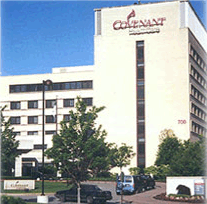
The U.S. Department of Justice and Michigan Attorney General Mike Cox are suing Michigan’s largest insurer, Blue Cross Blue Shield of Michigan, for forming anti-competitive contracts with hospitals, including St. Mary’s of Michigan and Covenant HealthCare in Saginaw.
Both St. Mary’s and Covenant have cooperated with the investigation, the attorney general’s office said.According to the lawsuit filed Monday, the insurance provider’s contracts includes clauses that require hospitals to charge other insurers more than they charge Blue Cross, giving Blue Cross an unlawful advantage. These clauses give Blue Cross the equivalent of “Most Favored Nation” status, according to the office of the attorney general, and result in “driving up prices for consumers and damaging competition in the health care market place — all to benefit Blue Cross’s market share.”
In all, 23 large and 45 rural Michigan hospitals were found to have entered into anti-competitive contracts with Blue Cross.
At Covenant, the Blue Cross contract requires the hospital to charge most of Blue Cross’s competitors at least 39 percent more than the hospital charges Blue Cross.
“When making business decisions, Covenant HealthCare keeps the best interest of our patients and our community at heart and is committed to providing the best possible care to any and all patients that seek medical attention 24 hours per day, 365 days per year,” said Kristin Knoll, a spokeswoman for Covenant.
Knoll said she could not discuss specifics of the lawsuit or contracts.
“However, a number of our patients are covered through contracts that are not subject to the Blue Cross Blue Shield of Michigan clause restrictions,” Knoll said.
“Covenant is complying with the Department of Justice to assist in any way possible with the investigation.”
A spokeswoman for St. Mary’s of Michigan said the hospital is aware of the lawsuit but is declining to comment at this time.
Blue Cross, a nonprofit insurance provider, defended its practices, saying the suit seeks to restrict the insurer’s ability to provide the most deeply discounted rates from Michigan hospitals.
Andrew Hetzel, a spokesman for Blue Cross, said the insurer’s contracts have saved customers billions of dollars.
“Negotiated hospital discounts are a tool that Blue Cross uses to protect the affordability of health insurance for millions of Michiganders,” Hetzel said.
“Through this lawsuit, the federal government seeks to deny millions of Michigan residents the lowest cost possible when they visit the hospital.”
He said the lawsuit will only hurt customers — of which it has about 4 million. Hetzel also said hospitals willingly enter into contracts with Blue Cross, which he said has 50 percent or less of the market share in most of the counties in the state.
“If this lawsuit succeeds and our ability to stipulate that Blue Cross will receive the deepest discounts is taken away from us, it will negatively change how our contracts work to benefit our members and customers,” Hetzel said.
“It will likely increase the cost of care that our customers receive in the hospital setting.”
Both St. Mary’s and Covenant have cooperated with the investigation, the attorney general’s office said.According to the lawsuit filed Monday, the insurance provider’s contracts includes clauses that require hospitals to charge other insurers more than they charge Blue Cross, giving Blue Cross an unlawful advantage. These clauses give Blue Cross the equivalent of “Most Favored Nation” status, according to the office of the attorney general, and result in “driving up prices for consumers and damaging competition in the health care market place — all to benefit Blue Cross’s market share.”
In all, 23 large and 45 rural Michigan hospitals were found to have entered into anti-competitive contracts with Blue Cross.
At Covenant, the Blue Cross contract requires the hospital to charge most of Blue Cross’s competitors at least 39 percent more than the hospital charges Blue Cross.
“When making business decisions, Covenant HealthCare keeps the best interest of our patients and our community at heart and is committed to providing the best possible care to any and all patients that seek medical attention 24 hours per day, 365 days per year,” said Kristin Knoll, a spokeswoman for Covenant.
Knoll said she could not discuss specifics of the lawsuit or contracts.
“However, a number of our patients are covered through contracts that are not subject to the Blue Cross Blue Shield of Michigan clause restrictions,” Knoll said.
“Covenant is complying with the Department of Justice to assist in any way possible with the investigation.”
A spokeswoman for St. Mary’s of Michigan said the hospital is aware of the lawsuit but is declining to comment at this time.
Blue Cross, a nonprofit insurance provider, defended its practices, saying the suit seeks to restrict the insurer’s ability to provide the most deeply discounted rates from Michigan hospitals.
Andrew Hetzel, a spokesman for Blue Cross, said the insurer’s contracts have saved customers billions of dollars.
“Negotiated hospital discounts are a tool that Blue Cross uses to protect the affordability of health insurance for millions of Michiganders,” Hetzel said.
“Through this lawsuit, the federal government seeks to deny millions of Michigan residents the lowest cost possible when they visit the hospital.”
He said the lawsuit will only hurt customers — of which it has about 4 million. Hetzel also said hospitals willingly enter into contracts with Blue Cross, which he said has 50 percent or less of the market share in most of the counties in the state.
“If this lawsuit succeeds and our ability to stipulate that Blue Cross will receive the deepest discounts is taken away from us, it will negatively change how our contracts work to benefit our members and customers,” Hetzel said.
“It will likely increase the cost of care that our customers receive in the hospital setting.”
Justice Department files Suit against Blue Cross Blue Shield of Michigan
The Wall Street Journal

The U.S. Justice Department filed an antitrust lawsuit Monday against Blue Cross Blue Shield of Michigan, alleging that provisions of the insurer's agreements with hospitals are anticompetitive.
The department challenged the insurer's use of provisions known as "most favored nation clauses," which the department said guaranteed that no other insurance plans could obtain a better rate for hospital services than Blue Cross.
The clauses raise hospital prices, discourage discounting and prevent other insurers from entering the marketplace, the department alleged.
It said that some Blue Cross clauses required Michigan hospitals to charge the insurer's competitors 30% to 40% more for services. The department also alleged that Blue Cross effectively bought protection from competition by agreeing to pay higher prices to certain hospitals in order to obtain the clauses.
The department said the insurer used its market dominance to impose these clauses on half the hospitals in the state.
U.S. Assistant Attorney General Christine Varney, the department's antitrust chief, said the government's challenge to the Blue Cross clauses was significant beyond the Michigan health-care market.
"This cannot be allowed in Michigan, and let me be clear: We will challenge similar anticompetitive behavior anywhere else in the United States," Varney said during a briefing with reporters.
The civil lawsuit, filed in a Michigan federal court, seeks to prohibit Blue Cross from using or enforcing the most-favored-nation clauses. The suit does not seek monetary fines.
Blue Cross Blue Shield of Michigan said the lawsuit was without merit.
"Negotiated hospital discounts are a tool that Blue Cross uses to protect the affordability of health insurance for millions of Michiganders," Andrew Hetzel, the company's vice president for corporate communications, said in a statement. "Through this lawsuit, the federal government seeks to deny millions of Michigan residents the lowest cost possible when they visit the hospital."
Jeffrey Brennan, an antitrust lawyer with Dechert LLP, said the Justice Department has been concerned with most-favored-nation clauses between insurers and health care providers since at least the 1990s.
Brennan said the department's enforcement activity in this area can't always be measured by the prevalence of litigation because there have been times when insurers have dropped the clauses when facing a non-public investigation by the department.
The clauses, Brennan said, can be pro-competitive in certain circumstances and spur lower prices, which is why courts have not ruled them automatically illegal.
The department challenged the insurer's use of provisions known as "most favored nation clauses," which the department said guaranteed that no other insurance plans could obtain a better rate for hospital services than Blue Cross.
The clauses raise hospital prices, discourage discounting and prevent other insurers from entering the marketplace, the department alleged.
It said that some Blue Cross clauses required Michigan hospitals to charge the insurer's competitors 30% to 40% more for services. The department also alleged that Blue Cross effectively bought protection from competition by agreeing to pay higher prices to certain hospitals in order to obtain the clauses.
The department said the insurer used its market dominance to impose these clauses on half the hospitals in the state.
U.S. Assistant Attorney General Christine Varney, the department's antitrust chief, said the government's challenge to the Blue Cross clauses was significant beyond the Michigan health-care market.
"This cannot be allowed in Michigan, and let me be clear: We will challenge similar anticompetitive behavior anywhere else in the United States," Varney said during a briefing with reporters.
The civil lawsuit, filed in a Michigan federal court, seeks to prohibit Blue Cross from using or enforcing the most-favored-nation clauses. The suit does not seek monetary fines.
Blue Cross Blue Shield of Michigan said the lawsuit was without merit.
"Negotiated hospital discounts are a tool that Blue Cross uses to protect the affordability of health insurance for millions of Michiganders," Andrew Hetzel, the company's vice president for corporate communications, said in a statement. "Through this lawsuit, the federal government seeks to deny millions of Michigan residents the lowest cost possible when they visit the hospital."
Jeffrey Brennan, an antitrust lawyer with Dechert LLP, said the Justice Department has been concerned with most-favored-nation clauses between insurers and health care providers since at least the 1990s.
Brennan said the department's enforcement activity in this area can't always be measured by the prevalence of litigation because there have been times when insurers have dropped the clauses when facing a non-public investigation by the department.
The clauses, Brennan said, can be pro-competitive in certain circumstances and spur lower prices, which is why courts have not ruled them automatically illegal.
19 September 2010
State Attorney General Sues Blue Cross, Regulator over Rates
Detroit Free Press
The Michigan attorney general’s office has sued Blue Cross Blue Shield of Michigan and a state regulator over rate changes for some customers who buy insurance coverage to supplement Medicare.
The lawsuit filed today in Ingham County Circuit Court says the Office of Financial and Insurance Regulation should have held a public hearing. Attorney General Mike Cox calls the changes “illegally raising rates.”
Blue Cross and the regulator say the rate changes stem from elimination of a discount on so-called Medigap policies for people who don’t live in Michigan or do get help from employers in buying coverage.
The commissioner of the regulating office in June ordered an end to the discounts. Blue Cross says it’s complying with the order.
The lawsuit filed today in Ingham County Circuit Court says the Office of Financial and Insurance Regulation should have held a public hearing. Attorney General Mike Cox calls the changes “illegally raising rates.”
Blue Cross and the regulator say the rate changes stem from elimination of a discount on so-called Medigap policies for people who don’t live in Michigan or do get help from employers in buying coverage.
The commissioner of the regulating office in June ordered an end to the discounts. Blue Cross says it’s complying with the order.
01 June 2010
BCBS Hikes Rates in State
Health CMI
 Blue Cross Blue Shield of Michigan (BCBSM) has asked permission for a rate hike of up to 15% for nearly 200,000 individual subscribers. Hikes for group subscribers will range from 8-12%. The premium increase must be approved by the Michigan Office of Financial and Insurance Regulation for it to take effect. BCBSM claims that they will lose over $50 million dollars without the hike.
This may come as a surprise to many policy holders since Michigan’s insurance commissioner approved a 22% increase last year for both individual and group policy holders. Despite the increase, BCBSM claims to have lost nearly $100 million last year. Michigan Attorney General Mike Cox has questioned the loss claims since BCBSM increased its surplus by $528 million in 2009. That is profit on top of the already $2 billion surplus that the company holds. Cox has also questioned the purported losses because the State of Michigan gives the company $100 million in tax breaks every year to help control costs and prevent losses.
Last year, Attorney General Cox asked Blue Cross Blue Shield of Michigan pointed questions about their finances. In a letter to BCBSM, Cox asked about bonuses and salaries to board members, perks such as entertainment expenses, and the total value of the BCBSM art collection. Cox also asked for BCBSM to state the amount of funds transferred to affiliated companies. The Attorney General estimated the transfer of funds out of BCBSM to be over $450 million since 2005. Such a transfer would then show up as a loss for the company even though the funds are received by affiliates. This line of inquiry shows that the Michigan Attorney General suspects clever accounting techniques and financial manipulation to help show a loss for BCBSM.
At the same time, Michigan Congressmen John D. Dingell and Sander Levin questioned Blue Cross Blue Shield of Michigan President and CEO Daniel J. Loepp about proposed rate hikes. The Congressmen asked questions concerning how much of the rate hikes will go towards paying benefits to subscribers, why the BCBSM massive surplus is not used to offset any losses, and what types of bonuses did employees making more than $500,000 per year receive. This line of inquiring was partially triggered by BCBSM paying enormous bonuses to executives prior to announcing a reduction of its workforce, salary freezes, and rate hikes. Blue Cross Blue Shield of Michigan CEO Leopp had a 23% increase in salary in 2009 to $1.12 million. However, his bonus pay has now dropped to approximately $650,000 down from last year’s $888,269.
14 January 2010
Saginaw City, County, and Community Schools Sue BCBS of Michigan
mLive
Saginaw County, the city of Saginaw and Saginaw Township Community Schools have filed lawsuits against Blue Cross/Blue Shield of Michigan, claiming the insurer overcharged a total of about $7 million in “secret” fees they say they didn’t know were assessed.

The county has claimed the insurer overcharged it $4 million, while the township schools have estimated the amount reached $1.8 million. Both suits were filed in Saginaw County Circuit Court.
The fees, imposed on the county and the schools in 1994, weren’t disclosed until 2008, court filings said.
Meanwhile, the city of Saginaw is part of a lawsuit filed in Genesee County Circuit Court that seeks more than $1 million against the insurer over the same issue, said William H. Horton, a Troy attorney who represents the city, the county and the township schools.
Lawyers have sought to make that case a class action lawsuit with the Genesee County Road Commission and Tuscola and Cass counties, said Elizabeth A. Favaro, also an attorney for the plaintiffs.
Attorneys argued the city, schools and the county weren’t told of the “secret and hidden fee” added to hospital claims in addition to administrative and “stop loss” fees for catastrophic insurance coverage that were disclosed, Favaro and court records said.
The fees, imposed on the county and the schools in 1994, weren’t disclosed until 2008, court filings said.
Meanwhile, the city of Saginaw is part of a lawsuit filed in Genesee County Circuit Court that seeks more than $1 million against the insurer over the same issue, said William H. Horton, a Troy attorney who represents the city, the county and the township schools.
Lawyers have sought to make that case a class action lawsuit with the Genesee County Road Commission and Tuscola and Cass counties, said Elizabeth A. Favaro, also an attorney for the plaintiffs.
Attorneys argued the city, schools and the county weren’t told of the “secret and hidden fee” added to hospital claims in addition to administrative and “stop loss” fees for catastrophic insurance coverage that were disclosed, Favaro and court records said.
Several Michigan counties have filed lawsuits against the insurer over the same issue, court records said.
Blue Cross/Blue Shield has denied wrongdoing. It said the plaintiffs failed to show evidence they didn’t know of the disputed charge, called an administrative services contract access fee, court records said.
“We’ve also demanded that (Blue Cross) stop charging these (access) fees,” Horton said.
The city, county and the school district are self-insured but use Blue Cross/Blue Shield to manage health insurance premium funds.
The insurer charges the access fee as part of the billed cost to handle the claims, court records said.
“These fees were expressly authorized by the Blue Cross contract,” said Blue Cross spokeswoman Helen Stojic, who added that group savings on hospital claims “year after year” gave the city, school district and the county “substantial savings that far exceed the fees.”
She did not have an exact amount.
“It’s unfortunate that knowing these facts, the groups and their attorneys have chosen to take legal action,” she said. “Despite the legal action, all of the groups continue to do business with us.
“We don’t believe these cases will be successful.”
Deputy County Controller Charles H. Cleaver said keeping Blue Cross to manage the self-insured fund doesn’t mean the county is satisfied.
“If we were happy with that, we wouldn’t file a lawsuit,” he said.
In late December opinions released this week, Saginaw County Circuit Judge Fred L. Borchard ruled against Blue Cross/Blue Shield’s motion to dismiss the county and school district’s lawsuit. Borchard also denied the request of both plaintiffs for an immediate finding of a breach of contract. The judge’s opinion said the contract language on the access fee was “ambiguous,” but he would leave it to a jury to decide if a breach of contract occurred.
Any money that the county might recover would go into an employee health insurance fund, Cleaver said. It’s premature to say how the schools might handle a judgment, Favaro said.
Several Michigan counties have filed lawsuits against the insurer over the same issue, court records said.
In a settlement with Oakland County, Blue Cross/Blue Shield agreed to pay $650,000 and provide three years of free administration of Oakland’s self-insured plan, The Detroit News reported in November. The free administration was worth $8.5 million to the southeast Michigan county, one official estimated.
“We’ve also demanded that (Blue Cross) stop charging these (access) fees,” Horton said.
The city, county and the school district are self-insured but use Blue Cross/Blue Shield to manage health insurance premium funds.
The insurer charges the access fee as part of the billed cost to handle the claims, court records said.
“These fees were expressly authorized by the Blue Cross contract,” said Blue Cross spokeswoman Helen Stojic, who added that group savings on hospital claims “year after year” gave the city, school district and the county “substantial savings that far exceed the fees.”
She did not have an exact amount.
“It’s unfortunate that knowing these facts, the groups and their attorneys have chosen to take legal action,” she said. “Despite the legal action, all of the groups continue to do business with us.
“We don’t believe these cases will be successful.”
Deputy County Controller Charles H. Cleaver said keeping Blue Cross to manage the self-insured fund doesn’t mean the county is satisfied.
“If we were happy with that, we wouldn’t file a lawsuit,” he said.
In late December opinions released this week, Saginaw County Circuit Judge Fred L. Borchard ruled against Blue Cross/Blue Shield’s motion to dismiss the county and school district’s lawsuit. Borchard also denied the request of both plaintiffs for an immediate finding of a breach of contract. The judge’s opinion said the contract language on the access fee was “ambiguous,” but he would leave it to a jury to decide if a breach of contract occurred.
Any money that the county might recover would go into an employee health insurance fund, Cleaver said. It’s premature to say how the schools might handle a judgment, Favaro said.
Several Michigan counties have filed lawsuits against the insurer over the same issue, court records said.
In a settlement with Oakland County, Blue Cross/Blue Shield agreed to pay $650,000 and provide three years of free administration of Oakland’s self-insured plan, The Detroit News reported in November. The free administration was worth $8.5 million to the southeast Michigan county, one official estimated.
07 January 2010
Michigan BCBS Adds U Of M To PPO
Ann Arbor dot Com

The University of Michigan has been added to Blue Cross Blue Shield of Michigan's Medicare Advantage Network and will allow seniors who purchase the plan to access any provider at the U-M hospitals, it was announced Wednesday.
The Medicare Plus Blue PPO, which was announced in October, has lower premiums than the original Medicare Supplemental Plan C product, plus the Medicare Part D prescription drug plan, and offers additional benefits, the non-profit insurer said.
For instance, premiums will cost between $61 and $141 under the Medicare Plus Blue PPO, compared to $183 per month with the supplemental Plan C product. The PPO plan has preventative dental services, routine physicals, exanded home infusion therapy, prescription drug coverage, total body skin exams and resources to navigate the health care system, according to a release.
The network has 23,000 physicians and 136 hospitals in Michigan. Open enrollment is Jan. 1 through March 31. For more information, call 877-469-2583 or visit bcbsm.com.
The Medicare Plus Blue PPO, which was announced in October, has lower premiums than the original Medicare Supplemental Plan C product, plus the Medicare Part D prescription drug plan, and offers additional benefits, the non-profit insurer said.
For instance, premiums will cost between $61 and $141 under the Medicare Plus Blue PPO, compared to $183 per month with the supplemental Plan C product. The PPO plan has preventative dental services, routine physicals, exanded home infusion therapy, prescription drug coverage, total body skin exams and resources to navigate the health care system, according to a release.
The network has 23,000 physicians and 136 hospitals in Michigan. Open enrollment is Jan. 1 through March 31. For more information, call 877-469-2583 or visit bcbsm.com.
31 December 2009
Medigap Info Could Overwhelm
Blue Cross denies hiding its money-losing policy
Detroit Free Press
They wanted a Blue Cross Medigap plan for $112.12 a month each, just like Rita's cousin has. An independent insurance agent at the insurer's Southfield lobby gave them an application in October.
But back home, Cox, 81, a retired salaried Ford Motor Co. construction engineer, and his wife, 77, realized the policy the agent suggested was for Blue Care Network, a subsidiary of the insurer, a plan that would cost $203.33 a month for her and $254.49 for him.
Confused, they called their son, Mike, who happens to be Michigan's attorney general.

Mike Cox successfully fought to hold down a recent rate increase in Blue Cross Medigap policies. He has also accused the insurer several times in the past year of failing to adequately promote the money-losing Medigap policies.
Blue Cross spokesman Andy Hetzel said the insurer loses $1,000 on every Medigap policy.
Cox advised his parents to get the exact name of the policy from the cousin, then go back to the Southfield office and request an application. "And don't take no for an answer," Rita said her son told her.
They went back and left with an application for Legacy Medigap, the new name Blue Cross has given its Medigap policy. They also bought a separate Part D plan to pay for prescription drugs, as most seniors do because Medigap policies don't have drug coverage.
"They are hiding it," Rita Cox said of Blue Cross. "The ones being hurt are seniors."
The Coxes' experience underscores problems seniors have in trying to find out about Blue Cross Medigap policies.
Blue Cross denies it has hidden its Medigap policy or steered customers to its subsidiary. Some 2,200 seniors enrolled in the Legacy plan in the last month alone, a sign that "clearly there isn't a widespread issue with regard to accessing the application, filling it out or getting enrolled," Hetzel said. The insurer has made improvements to more prominently list Legacy Blue applications and information on its Web site.
Hetzel attributed confusion to the dozens of Michigan Medicare plans sold. "The Coxes' family experience unfortunately is what a lot of families go through right now," he said.
Some of the confusion stems from a new Medigap policy, MyBlue, offered by Blue Care Network, a subsidiary of Blue Cross.
MyBlue policies cost more because administrators can charge higher rates based on a person's age, gender, health status, weight and county of residence.
Blue Cross can't charge higher rates because it is required by state law, as Michigan's nonprofit insurer of last resort, to offer one price for its Medigap policies.
Insurance brokers also get no commission to sell Legacy Blue plans as they do for a Blue Care Network policy. The commission typically is 20% of a plan's monthly premium.
As a result, some brokers don't tell seniors about the Blue Cross Medicare products, according to several local insurance brokers. The ones that do, like Barbara Plecas, an insurance broker in Walled Lake, tell seniors about Legacy Blue because "it's the right thing to do," Plecas said.
Louis Isabell, general manager of the Wixom-based Allchoice insurance firm, said some of his clients who requested Legacy Blue applications in October still had not gotten them, so they bought plans from other insurers.
Detroit Free Press
John and Rita Cox had to find another Medicare policy this fall after Blue Cross Blue Shield of Michigan eliminated their plan.
They wanted a Blue Cross Medigap plan for $112.12 a month each, just like Rita's cousin has. An independent insurance agent at the insurer's Southfield lobby gave them an application in October.
But back home, Cox, 81, a retired salaried Ford Motor Co. construction engineer, and his wife, 77, realized the policy the agent suggested was for Blue Care Network, a subsidiary of the insurer, a plan that would cost $203.33 a month for her and $254.49 for him.
Confused, they called their son, Mike, who happens to be Michigan's attorney general.

Blue Cross spokesman Andy Hetzel said the insurer loses $1,000 on every Medigap policy.
Cox advised his parents to get the exact name of the policy from the cousin, then go back to the Southfield office and request an application. "And don't take no for an answer," Rita said her son told her.
They went back and left with an application for Legacy Medigap, the new name Blue Cross has given its Medigap policy. They also bought a separate Part D plan to pay for prescription drugs, as most seniors do because Medigap policies don't have drug coverage.
"They are hiding it," Rita Cox said of Blue Cross. "The ones being hurt are seniors."
The Coxes' experience underscores problems seniors have in trying to find out about Blue Cross Medigap policies.
Blue Cross denies it has hidden its Medigap policy or steered customers to its subsidiary. Some 2,200 seniors enrolled in the Legacy plan in the last month alone, a sign that "clearly there isn't a widespread issue with regard to accessing the application, filling it out or getting enrolled," Hetzel said. The insurer has made improvements to more prominently list Legacy Blue applications and information on its Web site.
Hetzel attributed confusion to the dozens of Michigan Medicare plans sold. "The Coxes' family experience unfortunately is what a lot of families go through right now," he said.
Some of the confusion stems from a new Medigap policy, MyBlue, offered by Blue Care Network, a subsidiary of Blue Cross.
MyBlue policies cost more because administrators can charge higher rates based on a person's age, gender, health status, weight and county of residence.
Blue Cross can't charge higher rates because it is required by state law, as Michigan's nonprofit insurer of last resort, to offer one price for its Medigap policies.
Insurance brokers also get no commission to sell Legacy Blue plans as they do for a Blue Care Network policy. The commission typically is 20% of a plan's monthly premium.
As a result, some brokers don't tell seniors about the Blue Cross Medicare products, according to several local insurance brokers. The ones that do, like Barbara Plecas, an insurance broker in Walled Lake, tell seniors about Legacy Blue because "it's the right thing to do," Plecas said.
Louis Isabell, general manager of the Wixom-based Allchoice insurance firm, said some of his clients who requested Legacy Blue applications in October still had not gotten them, so they bought plans from other insurers.
06 November 2009
BCBS Of Michigan Awards Grants To 47 Free Health Clinics
Reuters
Blues contribution to free clinics makes health care accessible to the uninsured and underinsured.

DETROIT -- Blue Cross Blue Shield of Michigan is awarding free clinics throughout the state a total of $1 million in grants that will provide health services to individuals and families without Michigan health insurance. With the Michigan unemployment rate currently at 15.3 percent more Michigan residents than ever are going without health insurance.
"In these difficult times, free clinics are putting health care in reach for people who need it," said Lynda Rossi, Blues vice president for Social Mission and Public Affairs. "Free clinics are a place for uninsured people to turn to for quality health care. Uninsured residents who get care in free clinics often otherwise would delay seeing a physician because of the cost. Delay
often leads to more expensive care in emergency rooms and even hospital stays."
The Blues have contributed $5 million to free clinics since 2005. This year's grant program aims to help clinics provide important services like primary care and behavioral health care, case management, dental services, specialty and diagnostic care, and prescription drugs.
"Most of our patients are dealing with one or more long-term diseases such as diabetes, high blood pressure and asthma," said Dave Law, executive director of the Joy-Southfield Health and Education Center in Detroit. "We also supplement our primary care with preventive health education and disease management strategies."
About 2.5 million Michigan residents under 65 years old went without health insurance at some time between 2007 and 2008. Many of these individuals, along with the underinsured, are able to seek medical care from these clinics instead of making a trip to the emergency room or forgoing care. Access to free clinics also helps curb the rising cost of health care. In 2008, Michigan free clinics were able to provide an estimated 122,000 patient visits
combined. Most other residents over 65 are covered under Michigan medicaid or Michigan medicare.
"With this grant from Blue Cross Blue Shield of Michigan we will be able to expand our scope and quality of services while using health information technology to efficiently measure health outcomes. As a result, we will be able to deliver high-quality, low-cost health care to our patients at no cost to them," said Law.
The following free clinics received a grant from the Blues this year:
Southeast Michigan
-- Brownstown Twp. - Wyandotte Clinic for the Working Uninsured, 23050
West
Rd., Suite 260, 734-365-3560
-- Detroit - HUDA Clinic, 1605 W. Davison Ave., 313-865-8446
-- Detroit - Joy-Southfield Health and Education Center, 18917 Joy Rd.,
313-581-7773
-- Detroit - Order of Malta Medical/Dental Clinic, 4860 15th St.,
313-894-2240
-- Detroit - St. Frances Cabrini Clinic, 1234 Porter St., 313-961-7863
-- Detroit - University of Detroit Mercy Counseling Clinic, 4001 W.
McNichols, 313-993-1093
-- Mt. Clemens - Mt. Clemens Regional Medical Center Medical Outreach
Clinic, 1000 Harrington Blvd., 586-493-8000
-- Pontiac - Gary Burnstein Community Health Clinic, 90 W. University,
248-758-1690
-- Pontiac - Mercy Place Clinic, 55 Clinton Street, 248-333-0840
-- Southfield - Tri-County Dental Health Council, 29350 Southfield Rd.,
Suite 35, 248-559-7767
-- Warren - St. John Community Health, 28000 Dequindre, 586-753-1484
-- West Bloomfield - Project Chessed (Jewish Family Services), 6555 W.
Maple Rd., 248-592-2300
-- Westland - Project H, Wayne County Family Center, 30600 Michigan Ave.
-- Ypsilanti - Hope Dental Clinic, 9 S. Adams, 734-481-0111
Mid-Michigan
-- Brighton - VINA Community Dental Center, 400 E. Grand River Ave.,
810-844-0240
-- Hillsdale - St. Peter's Free Clinic of Hillsdale County Inc., 3 N.
Broad
St., 517-437-4041
-- Jackson - St. Luke's Clinic, 132 Seymour Ave., 517-783-1117
-- Lansing - Care Free Medical & Dental, 5135 S. Pennsylvania Ave.,
517-887-5992
-- Pinckney - Faith Medical Clinic, 122 Howell St., 734-474-4627
Flint/Tri-Cities
-- Essexville - Helen M. Nickless Volunteer Clinic, 1460 W. Center Rd.,
989-895-4830
-- Flint - Genesee County Free Medical Clinic, 2437 Welch Blvd.,
810-235-4211
-- Lapeer - Loving Hands Clinic, 148 Maple Grove Rd., 810-667-8933
-- Saginaw - Cathedral Mental Health Care, 705 Hoyt Ave., 989-759-3356
-- Saginaw - Community Prescription Support Program, 401 Holden St.,
989-907-5602
-- Saginaw - Healthy Futures of St. Mary's of Michigan, 2215 N. Center
Rd.,
989-907-8108
West Michigan
-- Allegan - Seeds of Grace, 311 ½ Hubbard St., 269-288-0253
-- Battle Creek - Nursing Clinic of Battle Creek, 34 Green St.,
269-962-6565
-- Coldwater - Presbyterian Health Clinic of Branch County, 15 Church
St.,
517-278-7848
-- Grand Rapids - Catherine's Care Center, 224 Carrier NE, 616-336-8800
-- Grand Rapids - Health Intervention Services, 15 Andre SE, 616-475-8446
-- Grand Rapids - Oasis of Hope Center, 522 Leonard St. NW, 616-451-8868
-- Grand Rapids - Project Access, 233 E. Fulton, Suite 226, 616-459-1111
-- Hastings - Barry Community Free Clinic, 1230 W. State St.,
269-945-4444
-- Holland - Holland Free Health Clinic, 99 W. 26th St., 616-392-3610
-- Kalamazoo - Free Clinic of Kalamazoo, 2918 Portage St., 269-344-0044
-- Marshall - Fountain Clinic, 111 N. Jefferson, 269-781-0952
-- Three Rivers - Riverside Health Clinic, 207 E. Michigan Ave.,
269-273-3744
-- Zeeland - City on a Hill Ministries Health Clinic, 100 S. Pine St.,
Suite 140, 616-748-6009
Northern Lower Peninsula and Upper Peninsula
-- Big Rapids - Hope House Free Medical Clinic, 15085 220th Ave.,
231-796-0807
-- Cadillac - Cadillac Area Community Health Clinic, 521 Cobbs St.,
231-876-7818
-- Cheboygan - Northern Care Center, 225 Water St., 231-333-3019
-- Grayling - AuSable Free Clinic Inc., 1250 E. Michigan Ave.,
989-348-0740
-- Manistee - Manistee Area Community Clinic, 385 Third St., 231-309-8940
-- Petoskey - Community Free Clinic, 820 Arlington, Suite 6, 231-487-3600
-- Traverse City - Traverse Health Clinic, 3147 Logan Valley Rd.,
231-935-0668
-- Marquette - Medical Care Access Coalition Volunteer Clinic, 1414 W.
Fair Ave., Suite 26, 906-226-4400
-- Sault Ste. Marie - Community Health Access Coalition Volunteer Clinic,
508 Ashmun St., 906-635-7451
Blue Cross Blue Shield of Michigan has a unique mission that is different from other health insurance companies. The company is committed to focusing on reducing health care costs and improving quality, increasing access to health care coverage and services, and improving the health status of Michigan's residents, particularly children.
BCBS of Michigan is also concerned with senior services, including:
Assisted Living in Dearborn
Retirement Facilities in Dearborn
Senior Living in Wayne County
Blue Cross Blue Shield of Michigan, a nonprofit organization, provides and administers health benefits to 4.7 million members residing in Michigan in addition to members of Michigan-headquartered groups who reside outside the state. The company offers a broad variety of plans including:
Traditional Blue Cross Blue Shield; Blue Preferred®, Community Blue(SM) and Healthy Blue Incentives(SM) PPOs; Blue Care Network HMO; BCN's Healthy Blue Living(SM); Flexible Blue(SM) plans compatible with health savings accounts; Medicare Advantage; Part D Prescription Drug plans, and MyBlue(SM) products in the under-age-65 individual market. BCBSM also offers dental, vision and hearing plans. Blue Cross Blue Shield of Michigan and Blue Care Network are nonprofit corporations and independent licensees of the Blue Cross and Blue Shield Association. For more company information, visit bcbsm.com.
SOURCE Blue Cross Blue Shield of Michigan
Blues contribution to free clinics makes health care accessible to the uninsured and underinsured.

DETROIT -- Blue Cross Blue Shield of Michigan is awarding free clinics throughout the state a total of $1 million in grants that will provide health services to individuals and families without Michigan health insurance. With the Michigan unemployment rate currently at 15.3 percent more Michigan residents than ever are going without health insurance.
"In these difficult times, free clinics are putting health care in reach for people who need it," said Lynda Rossi, Blues vice president for Social Mission and Public Affairs. "Free clinics are a place for uninsured people to turn to for quality health care. Uninsured residents who get care in free clinics often otherwise would delay seeing a physician because of the cost. Delay
often leads to more expensive care in emergency rooms and even hospital stays."
The Blues have contributed $5 million to free clinics since 2005. This year's grant program aims to help clinics provide important services like primary care and behavioral health care, case management, dental services, specialty and diagnostic care, and prescription drugs.
"Most of our patients are dealing with one or more long-term diseases such as diabetes, high blood pressure and asthma," said Dave Law, executive director of the Joy-Southfield Health and Education Center in Detroit. "We also supplement our primary care with preventive health education and disease management strategies."
About 2.5 million Michigan residents under 65 years old went without health insurance at some time between 2007 and 2008. Many of these individuals, along with the underinsured, are able to seek medical care from these clinics instead of making a trip to the emergency room or forgoing care. Access to free clinics also helps curb the rising cost of health care. In 2008, Michigan free clinics were able to provide an estimated 122,000 patient visits
combined. Most other residents over 65 are covered under Michigan medicaid or Michigan medicare.
"With this grant from Blue Cross Blue Shield of Michigan we will be able to expand our scope and quality of services while using health information technology to efficiently measure health outcomes. As a result, we will be able to deliver high-quality, low-cost health care to our patients at no cost to them," said Law.
The following free clinics received a grant from the Blues this year:
Southeast Michigan
-- Brownstown Twp. - Wyandotte Clinic for the Working Uninsured, 23050
West
Rd., Suite 260, 734-365-3560
-- Detroit - HUDA Clinic, 1605 W. Davison Ave., 313-865-8446
-- Detroit - Joy-Southfield Health and Education Center, 18917 Joy Rd.,
313-581-7773
-- Detroit - Order of Malta Medical/Dental Clinic, 4860 15th St.,
313-894-2240
-- Detroit - St. Frances Cabrini Clinic, 1234 Porter St., 313-961-7863
-- Detroit - University of Detroit Mercy Counseling Clinic, 4001 W.
McNichols, 313-993-1093
-- Mt. Clemens - Mt. Clemens Regional Medical Center Medical Outreach
Clinic, 1000 Harrington Blvd., 586-493-8000
-- Pontiac - Gary Burnstein Community Health Clinic, 90 W. University,
248-758-1690
-- Pontiac - Mercy Place Clinic, 55 Clinton Street, 248-333-0840
-- Southfield - Tri-County Dental Health Council, 29350 Southfield Rd.,
Suite 35, 248-559-7767
-- Warren - St. John Community Health, 28000 Dequindre, 586-753-1484
-- West Bloomfield - Project Chessed (Jewish Family Services), 6555 W.
Maple Rd., 248-592-2300
-- Westland - Project H, Wayne County Family Center, 30600 Michigan Ave.
-- Ypsilanti - Hope Dental Clinic, 9 S. Adams, 734-481-0111
Mid-Michigan
-- Brighton - VINA Community Dental Center, 400 E. Grand River Ave.,
810-844-0240
-- Hillsdale - St. Peter's Free Clinic of Hillsdale County Inc., 3 N.
Broad
St., 517-437-4041
-- Jackson - St. Luke's Clinic, 132 Seymour Ave., 517-783-1117
-- Lansing - Care Free Medical & Dental, 5135 S. Pennsylvania Ave.,
517-887-5992
-- Pinckney - Faith Medical Clinic, 122 Howell St., 734-474-4627
Flint/Tri-Cities
-- Essexville - Helen M. Nickless Volunteer Clinic, 1460 W. Center Rd.,
989-895-4830
-- Flint - Genesee County Free Medical Clinic, 2437 Welch Blvd.,
810-235-4211
-- Lapeer - Loving Hands Clinic, 148 Maple Grove Rd., 810-667-8933
-- Saginaw - Cathedral Mental Health Care, 705 Hoyt Ave., 989-759-3356
-- Saginaw - Community Prescription Support Program, 401 Holden St.,
989-907-5602
-- Saginaw - Healthy Futures of St. Mary's of Michigan, 2215 N. Center
Rd.,
989-907-8108
West Michigan
-- Allegan - Seeds of Grace, 311 ½ Hubbard St., 269-288-0253
-- Battle Creek - Nursing Clinic of Battle Creek, 34 Green St.,
269-962-6565
-- Coldwater - Presbyterian Health Clinic of Branch County, 15 Church
St.,
517-278-7848
-- Grand Rapids - Catherine's Care Center, 224 Carrier NE, 616-336-8800
-- Grand Rapids - Health Intervention Services, 15 Andre SE, 616-475-8446
-- Grand Rapids - Oasis of Hope Center, 522 Leonard St. NW, 616-451-8868
-- Grand Rapids - Project Access, 233 E. Fulton, Suite 226, 616-459-1111
-- Hastings - Barry Community Free Clinic, 1230 W. State St.,
269-945-4444
-- Holland - Holland Free Health Clinic, 99 W. 26th St., 616-392-3610
-- Kalamazoo - Free Clinic of Kalamazoo, 2918 Portage St., 269-344-0044
-- Marshall - Fountain Clinic, 111 N. Jefferson, 269-781-0952
-- Three Rivers - Riverside Health Clinic, 207 E. Michigan Ave.,
269-273-3744
-- Zeeland - City on a Hill Ministries Health Clinic, 100 S. Pine St.,
Suite 140, 616-748-6009
Northern Lower Peninsula and Upper Peninsula
-- Big Rapids - Hope House Free Medical Clinic, 15085 220th Ave.,
231-796-0807
-- Cadillac - Cadillac Area Community Health Clinic, 521 Cobbs St.,
231-876-7818
-- Cheboygan - Northern Care Center, 225 Water St., 231-333-3019
-- Grayling - AuSable Free Clinic Inc., 1250 E. Michigan Ave.,
989-348-0740
-- Manistee - Manistee Area Community Clinic, 385 Third St., 231-309-8940
-- Petoskey - Community Free Clinic, 820 Arlington, Suite 6, 231-487-3600
-- Traverse City - Traverse Health Clinic, 3147 Logan Valley Rd.,
231-935-0668
-- Marquette - Medical Care Access Coalition Volunteer Clinic, 1414 W.
Fair Ave., Suite 26, 906-226-4400
-- Sault Ste. Marie - Community Health Access Coalition Volunteer Clinic,
508 Ashmun St., 906-635-7451
Blue Cross Blue Shield of Michigan has a unique mission that is different from other health insurance companies. The company is committed to focusing on reducing health care costs and improving quality, increasing access to health care coverage and services, and improving the health status of Michigan's residents, particularly children.
BCBS of Michigan is also concerned with senior services, including:
Assisted Living in Dearborn
Retirement Facilities in Dearborn
Senior Living in Wayne County
Blue Cross Blue Shield of Michigan, a nonprofit organization, provides and administers health benefits to 4.7 million members residing in Michigan in addition to members of Michigan-headquartered groups who reside outside the state. The company offers a broad variety of plans including:
Traditional Blue Cross Blue Shield; Blue Preferred®, Community Blue(SM) and Healthy Blue Incentives(SM) PPOs; Blue Care Network HMO; BCN's Healthy Blue Living(SM); Flexible Blue(SM) plans compatible with health savings accounts; Medicare Advantage; Part D Prescription Drug plans, and MyBlue(SM) products in the under-age-65 individual market. BCBSM also offers dental, vision and hearing plans. Blue Cross Blue Shield of Michigan and Blue Care Network are nonprofit corporations and independent licensees of the Blue Cross and Blue Shield Association. For more company information, visit bcbsm.com.
SOURCE Blue Cross Blue Shield of Michigan
05 July 2009
Blue Cross Grants Additional $6 Million To MHA
Story from Crain's Detroit Business
Blue Cross Blue Shield of Michigan has decided to provide a second $6 million grant to the Michigan Health and Hospital Association for research to improve health care quality and patient safety, and to reduce costs.
 The Blues made an initial $6 million grant in 2004.
The funding will go to MHA’s Keystone Center for Patient Safety and Quality.
“The MHA Keystone Center projects have already delivered a phenomenal return in improving safety and quality,” said Blue Cross CEO Dan Loepp in a statement.
Most of Michigan’s 144 hospitals have participated in the center’s projects – that include reducing hospital-acquired infections, improving care for mothers and newborns and increasing patient flow in emergency departments.
For example, improving quality in hospital intensive care units the past four years have saved 1,800 lives, cut 129,000 hospital days and saved $247 million in unnecessary costs, Blue Cross said.
Hospitals also have saved more than $10 million by reducing urinary tract infections acquired from hospital catheters.
Spencer Johnson, MHA president, said patient lives have been saved by following best practices discovered through the research.
“The Michigan hospitals that participate in the MHA Keystone Center programs have achieved significant, measurable patient safety improvements – errors have been reduced and lives have been saved,” said Johnson in a statement.
Blue Cross Blue Shield of Michigan has decided to provide a second $6 million grant to the Michigan Health and Hospital Association for research to improve health care quality and patient safety, and to reduce costs.
 The Blues made an initial $6 million grant in 2004.
The funding will go to MHA’s Keystone Center for Patient Safety and Quality.
“The MHA Keystone Center projects have already delivered a phenomenal return in improving safety and quality,” said Blue Cross CEO Dan Loepp in a statement.
Most of Michigan’s 144 hospitals have participated in the center’s projects – that include reducing hospital-acquired infections, improving care for mothers and newborns and increasing patient flow in emergency departments.
The Center's projects include reducing hospital-acquired infections, improving care for mothers and newborns and increasing patient flow in emergency departments.
For example, improving quality in hospital intensive care units the past four years have saved 1,800 lives, cut 129,000 hospital days and saved $247 million in unnecessary costs, Blue Cross said.
Hospitals also have saved more than $10 million by reducing urinary tract infections acquired from hospital catheters.
Spencer Johnson, MHA president, said patient lives have been saved by following best practices discovered through the research.
“The Michigan hospitals that participate in the MHA Keystone Center programs have achieved significant, measurable patient safety improvements – errors have been reduced and lives have been saved,” said Johnson in a statement.
29 May 2009
Attorney General Protests Blue Cross Rate Hikes, Offers Own Plan
Story from the Detroit Free Press
Michigan Attorney General Mike Cox filed a petition Thursday to stop proposed individual rate hikes for more than 400,000 individual Blue Cross Blue Shield of Michigan customers.
Advertisement
 "Blue Cross should stop putting profits over people and focus on its mission as the insurer of last resort," Cox said in a statement announcing the challenge.
Overall, average increases sought would be 56% for non-elderly people buying their own insurance; 42% for group conversion policyholders who purchase coverage they once had at work, and 31% for seniors with supplemental Medicare, also known as Medigap policies.
Michigan's Office of Financial and Insurance Regulation was to have ruled on the rate hikes by June 2. Now the office has 30 days from Thursday to hold the hearing.
Blue Cross has said it needs the rate hikes to offset mounting losses for its individual policies, to exceed $1 billion through 2011, according to Blue Cross estimates. It also is laying off or not filling 1,000 jobs, has frozen executive and board salaries and cut spending on advertising, lobbying and other expenses, the Detroit-based company has said.
In a statement, Blue Cross said that it would prefer not to raise rates but "unfortunately our broken regulatory system puts us in this uncomfortable position."
Cox has had mixed results with rate challenges.
He and Ann Arbor attorney Joe Aoun lost a challenge earlier this month of 2007 Blue Cross rate hikes for non-elderly people who buy their own Michigan health insurance. But Cox won a separate challenge in 2007 to raising Medigap rates.
Cox has issued his own 10-point plan to reform Michigan's health insurance industry. He said challenges like the one he filed Thursday will be reduced by proposals pending in the House.
Rep. Marc Corriveau, D-Northville, said he has tried unsuccessfully to work with Cox to frame the bills to retain his oversight. His proposals would allow the Attorney General to file a challenge to a rate hike, but would shorten the time he could do it.
Michigan Attorney General Mike Cox filed a petition Thursday to stop proposed individual rate hikes for more than 400,000 individual Blue Cross Blue Shield of Michigan customers.
Advertisement
 "Blue Cross should stop putting profits over people and focus on its mission as the insurer of last resort," Cox said in a statement announcing the challenge.
Overall, average increases sought would be 56% for non-elderly people buying their own insurance; 42% for group conversion policyholders who purchase coverage they once had at work, and 31% for seniors with supplemental Medicare, also known as Medigap policies.
Michigan's Office of Financial and Insurance Regulation was to have ruled on the rate hikes by June 2. Now the office has 30 days from Thursday to hold the hearing.
Blue Cross has said it needs the rate hikes to offset mounting losses for its individual policies, to exceed $1 billion through 2011, according to Blue Cross estimates. It also is laying off or not filling 1,000 jobs, has frozen executive and board salaries and cut spending on advertising, lobbying and other expenses, the Detroit-based company has said.
In a statement, Blue Cross said that it would prefer not to raise rates but "unfortunately our broken regulatory system puts us in this uncomfortable position."
Cox has had mixed results with rate challenges.
He and Ann Arbor attorney Joe Aoun lost a challenge earlier this month of 2007 Blue Cross rate hikes for non-elderly people who buy their own Michigan health insurance. But Cox won a separate challenge in 2007 to raising Medigap rates.
Cox has issued his own 10-point plan to reform Michigan's health insurance industry. He said challenges like the one he filed Thursday will be reduced by proposals pending in the House.
Rep. Marc Corriveau, D-Northville, said he has tried unsuccessfully to work with Cox to frame the bills to retain his oversight. His proposals would allow the Attorney General to file a challenge to a rate hike, but would shorten the time he could do it.
19 April 2009
BCBS of Michigan Raises The Price For Individual Health Coverage
Story from the Detroit News
 As more Michigan residents flock to Blue Cross Blue Shield of Michigan to buy their own Michigan health insurance, the state's largest insurer is replacing several types of individual policies with plans that will cost up to $600 a year more -- and come with higher co-payments and other out-of-pocket costs.
The new insurance plans -- with monthly premiums ranging from $51 to $292 per a person -- are on sale now and take effect Wednesday.
On March 27, Blue Cross stopped enrolling new consumers in several older plans, including Value Blue, a catastrophic coverage policy, and its no-deductible Individual Care Blue. The changes don't affect Blue Cross members enrolled in those plans. Instead, the new rates will apply to newly unemployed residents seeking to replace workplace coverage by buying their own insurance from Blue Cross. The new plans also differ from those for which Blue Cross is seeking state permission to raise rates and would not be affected if that request is approved.
With the rollout of these new plans, Blue Cross has introduced a lengthy application that includes optional health questions and ties insurance agents' commissions to the medical condition of new enrollees.
The changes are so drastic that some insurance agents say Blue Cross is deliberately making its money-losing individual policies less attractive to slow sales. Blue Cross contends that it's simply keeping up with market trends, as well as the rates and plan offerings of its private-sector competitors.
As the state's insurer of last resort -- a responsibility tied to its tax-exempt status -- Blue Cross must cover all Michigan residents, regardless of their medical history. But that arrangement, Blue Cross officials say, leaves them with the state's sickest and costliest members. Last year, Blue Cross lost $133.2 million on individual insurance policies, dragging its bottom line to a $144.9 million loss for 2008.
Insurance agents say the new rates will make it harder to sell the plans. New members aren't going to want to pay more in premiums for higher out-of-pocket costs, especially if there are better deals offered by other insurers.
"It's not good for the consumer," said Patrick Pennefather, president of the Michigan Association of Health Underwriters, which represents Michigan health insurance company agents and buyers for employer groups. The new plans, he added, are going to slow down sales for Blue Cross, a move that could help stem the rising tide of losses on individual policies.
Some agents are likely to stop selling Blue Cross' individual policies altogether because the commission structure lowers incentives for enrolling sickly customers into its individual plans, Pennefather added.
Blue Cross's new incentive structure offers a 15 percent commission to agents who sign up healthy members and only 2 percent for signing new enrollees with severe medical problems. A 2 percent commission could translate into only a couple of dollars a month on some policies, say insurance agents, and is much lower than the 8 percent commissions previously offered by Blue Cross on all policies, regardless of the applicant's health status.
Blue Cross said the tiered commissions better match incentives offered by their rivals in the individual insurance market.
"It may drive a lot of agents out of the individual insurance business. In fact, many have said they plan to get out of it," Pennefather said, noting that agents can make 20 percent with other private insurers.
Some Blue Cross critics, including Michigan Attorney General Mike Cox, have questioned why Blue Cross is collecting health information, since that is at odds with the company's mission as the state's insurer of last resort. Cox's office has said it's investigating whether the changes are lawful.
Answering the questions about health status, however, is voluntary and won't affect consumer eligibility or rates, but will help applicants qualify for lower co-payments, Blue Cross officials said.
Blue Cross also points out that it still pays at least some portion of the commission to agents for all applicants. Most other insurers pay no commission if they end up rejecting the applicant, said Helen Stojic, a Blue Cross spokeswoman.
As for the new plan prices and coverage, Stojic said Blue Cross hopes to better reflect the marketplace, where deductibles and higher out-of-pocket maximums are common.
The insurer also contends its rates are still better than most plans for people with serious medical conditions.
"Our plans are aligned more closely with those in the market, with one important difference: We still don't medically underwrite and we are still the insurer of last resort," Stojic said.
Unlike rate hikes for existing customers, state regulators don't require Blue Cross to seek public input before introducing new plans or closing new enrollment in existing policies.
Blue Cross is seeking rate hikes on its existing individual policies that cover about 400,000 members. It's asking for an average rate hike on three types of policies: a 56 percent increase on individual plans, 42 percent on group conversion coverage (which extends benefits from a former employer) and 31 percent for Medigap plans.
Subscribe to:
Comments (Atom)


